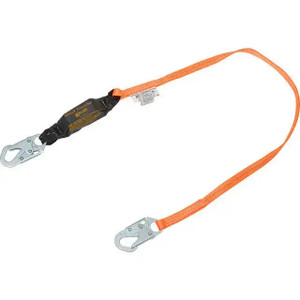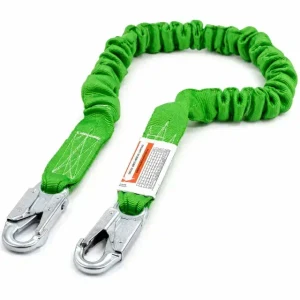


Miller BackBiter 6 ft Tie-Back Shock-Absorbing Lanyard
The Miller BackBiter 913B/6FTGN is a green, 6-foot single-leg tie-back lanyard with a SofStop shock absorber. Its dedicated Miller 5K hook supports the manufacturer’s tie-back arrangement around a suitable structural member. A separate locking snap hook connects at the harness end.
S913B/6FTGN
913B/6FTGN
6 ft; single leg
1-3/8 in polyester
Miller 5K locking snap hook
Steel locking snap hook
SofStop single pack
Key Features
- Purpose-built tie-back construction combines the lanyard and wraparound anchorage-connection function.
- The SofStop pack absorbs energy by extending under fall loading.
- Heavy-duty webbing provides abrasion resistance without establishing sharp-edge approval.
- The designated Miller 5K hook has a manufacturer-listed 5,000 lb gate-load capacity; this is not a user weight rating.
Common Uses
- Steel erection with a suitable assessed tie-back member.
- Construction and elevated industrial maintenance.
- Temporary work locations where the prescribed wrap and connection can be achieved.
Selection and Use
Only the designated tie-back end may be connected back to the lanyard as instructed. The two ends are not interchangeable: the technical sheet identifies a 5/8-inch opening for the Miller 5K hook and a 3/4-inch opening for the harness snap hook. Check structural strength, geometry and surface condition before wrapping a member. Protect against abrasion as instructed; avoid unapproved sharp-edge exposure.
Standards and Safety
Miller’s technical sheet lists ANSI Z359.13 and A10.32. For ANSI Z359.13 use, it specifies 130–310 lb total user weight. The sheet separately lists up to 400 lb under its OSHA configuration; follow the supplied label and all component limits. CSA ratings apply to specifically suffixed models, not automatically to 913B/6FTGN. Do not apply the document’s MAX-pack or 12-foot-free-fall specifications to this single-pack model.
Employers must select compatible components, provide training and plan for prompt rescue. OSHA 1926.502 addresses construction fall-protection systems; OSHA 1910.140 applies to general-industry personal fall protection. These are employer requirements, not OSHA product approvals.
Manufacturer Documents
FAQ
Does this provide 100% tie-off during anchor changes?
A single leg alone cannot maintain attachment while it is disconnected to change anchors. Plan a suitable continuous-connection system when the task requires one.
Are both hooks Miller 5K tie-back hooks?
No. This model uses a Miller 5K hook at the anchorage end and a separate locking harness snap hook.
Does tie-back capability make every structural member suitable?
No. The structure, wrap arrangement, clearances and connector loading must satisfy the complete fall-protection system requirements.