

Posted by ASA, LLC on Aug 12th 2026
How to Specify Cold Storage PPE for Freezer Work
A worker moving from a 70°F loading area into a freezer can lose dexterity, visibility, and control faster than many PPE programs account for. The right cold storage PPE system protects against cold exposure while preserving grip, mobility, visibility, and awareness around lift trucks, racks, conveyors, and wet floors.
For safety managers and procurement teams, the right answer is not one insulated coat. It is a job-specific PPE system built around freezer temperature, exposure time, worker activity level, moisture exposure, traffic conditions, and the other hazards present alongside the cold.
Start With the Actual Freezer Hazard
Cold storage PPE should begin with a documented hazard assessment. A worker doing short, active order-picking runs at 0°F has a different need than a seated lift-truck operator, a sanitation employee near wet floors, or a maintenance technician entering a deeper-freeze area. Duration matters as much as posted temperature.
Cold environments can reduce hand function, increase fatigue, and make routine tasks harder to perform safely. In freezer operations, those effects can create secondary risks such as dropped product, poor equipment control, slips, and delayed reactions around traffic or alarms.
Cold-contact hazards also matter. Metal doors, pallet jack handles, rails, tools, and controls can pull heat from underprotected hands immediately. PPE selection should address both ambient cold and contact with cold surfaces.
Build a Layered Cold Storage PPE System
A freezer jacket or suit is only one part of the system. Workers moving between docks, coolers, staging areas, and freezer rooms often need layers that can manage changing conditions without sacrificing function.
Base and Mid Layers Should Manage Moisture
The layer closest to the skin should help move moisture away from the body. Cotton is usually a poor choice for sustained cold work because it holds moisture and loses insulating value when damp. Moisture-managing base layers and insulating mid layers generally perform better for workers who walk, lift, and cycle repeatedly between warm and cold zones.
Supervisors should not assume one garment weight fits every role. Active selectors, seated equipment operators, and low-movement inventory staff may need different approved combinations.
Outerwear Should Match Exposure and Task
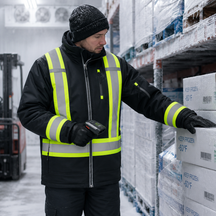
Freezer jackets, insulated bibs, coveralls, and freezer suits should be selected for the coldest expected conditions, the expected exposure duration, and the physical demands of the job. A full suit may make sense for prolonged exposure, while a jacket-and-bib combination may work better where bending, climbing, scanning, or vehicle operation matters more.
Look for durable outer materials, closures that can be used with gloves, reinforced wear zones, and cuff designs that overlap properly with gloves and footwear. For facilities building a layered system, freezer wear and insulated cold-weather clothing should be evaluated against the actual job, not just a general cold-weather label: https://asasupplies.com/extreme-cold-weather-clothing
Protect Hands, Feet, Head, and Vision
Extremities are often underprotected in freezer operations, especially when crews are rushed or the PPE makes routine tasks harder to perform.
Gloves Must Balance Warmth and Function
Cold-storage gloves should support both insulation and usable grip. Workers still need to scan labels, operate controls, grip handles, and manage cartons safely. Buyers comparing options for hand protection can review freezer gloves for warehouse and cold-storage work alongside their broader PPE specification: https://www.asasupplies.com/blog/how-to-choose-freezer-gloves-for-warehouse-work/
Where workers also face sharp edges, corrugate, or mixed handling tasks, cut-resistant gloves and sleeves may need to be part of the approved system: https://asasupplies.com/cut-resistant-gloves-and-sleeves
Footwear Must Address Impact and Slips
Where foot protection is required, insulation alone is not enough. In freezer and dock environments, buyers should evaluate slip conditions, outsole performance, fit with warm socks, and whether the boot still allows circulation and stable movement.
Cold floors, condensation near doorways, and icy transitions can make the wrong boot dangerous even when it feels warm enough. Footwear selection should reflect both cold exposure and the walking surfaces employees actually use.
Head, Face, and Eye Protection Must Stay Compatible
Hoods, liners, caps, balaclavas, and face coverings should work with any required hard hats, hearing protection, safety eyewear, or respirators. Fogging, moisture buildup, and blocked peripheral vision should be tested during real work tasks, not assumed away.
Where visibility problems are recurring, buyers may also need to review protective goggles and eye protection options that fit the environment and the rest of the PPE system: https://asasupplies.com/protective-goggles
Do Not Let Cold-Weather Gear Interfere With Other PPE
Freezer wear does not replace other required protection. Depending on the task, workers may still need high-visibility apparel, hard hats, cut protection, hearing protection, fall protection, chemical protection, or respiratory protection. The key question is compatibility.
Before standardizing gear, test the full combination in the real work environment. Can workers climb steps, grip steering controls, reach overhead, scan, hear alarms, and move safely in traffic areas while wearing the issued system?
Write a Repeatable PPE Specification
A strong freezer PPE program groups workers by exposure profile and defines a repeatable baseline for each group. Start with groups such as short-entry personnel, active freezer workers, seated operators, maintenance staff, and wet-area or sanitation crews.
A usable specification should document temperature range, expected exposure duration, garment type, visibility needs, glove requirements, footwear requirements, sizing expectations, and replacement triggers. Torn, wet, compressed, or poorly fitting freezer wear should be replaced before it undermines protection.
Procurement teams should also plan for replenishment. Standardizing a smaller number of approved jackets, bibs, gloves, and boots can simplify ordering, sizing, and replacement across shifts and locations.
Train for Real Use, Inspection, and Warm-Up
Workers should know how to layer garments, secure cuffs and closures, inspect gloves and footwear, dry PPE between shifts, and recognize cold-related warning signs early. Supervisors should provide warm-up access, dry replacement gear, and a clear process for reporting numbness, loss of dexterity, unusual fatigue, or other cold-related issues before they become injuries.
The best cold storage PPE program is the one workers can wear correctly for the full task, every shift, without sacrificing the protection their environment demands.
If your team is standardizing freezer apparel, hand protection, and related safety gear, request a quote from ASA, LLC to build a cold-storage PPE program around your facility conditions and worker tasks: https://www.asasupplies.com/request-a-quote/