

Posted by American Safety Associates, LLC on Aug 5th 2026
How to Choose Freezer Gloves for Warehouse Work
The best freezer gloves are not simply the thickest pair available. They must provide enough cold protection for the work environment while preserving the grip, dexterity, moisture control, and secondary-hazard protection required by the task.
A picker handling frozen cartons, a forklift operator using controls, and a maintenance employee working around sharp metal edges may need three different glove constructions. Safety and procurement teams should therefore select freezer gloves by job function rather than issuing one model throughout the facility without testing it.
This guide explains how to compare insulated freezer gloves for warehouse, food-distribution, refrigerated-dock, and cold-storage work.
Start With the Workplace Hazard Assessment
Before comparing glove materials, document the conditions workers actually encounter. OSHA requires employers to assess workplace hazards and select properly fitting PPE for the hazards identified. The assessment should account for cold exposure as well as cuts, punctures, chemicals, machinery, moisture, food-contact requirements, and other task-specific risks.
NIOSH advises workers in cold environments to protect their hands, prevent gloves from becoming wet, and avoid touching cold metal with bare skin. NIOSH also notes that highly efficient, thin insulation can help preserve dexterity.
For each job, record:
- Freezer or refrigerated-zone temperature
- Typical time spent in the cold and warm-up practices
- Contact with frozen products, cold metal, or wet packaging
- Required grip on cartons, tools, controls, and equipment
- Scanner, tablet, keypad, or touchscreen use
- Sharp edges, pallet damage, straps, or cut hazards
- Food-contact, sanitation, or chemical exposure requirements
- Cuff and sleeve compatibility
- Sizes needed across the workforce
A glove labeled for cold work is not automatically appropriate for every hazard on this list.
Match Freezer Gloves to the Work Task
Case Picking and Frozen-Food Handling
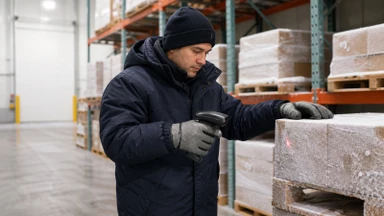
Workers picking cases or moving frozen products need insulation, dependable grip, and enough finger movement to handle labels, cartons, and pallet wrap. A bulky glove may feel warm while the hand is still, but it can increase drops or encourage workers to remove the glove for detailed tasks.
When comparing freezer gloves for handling frozen food, check whether the palm maintains grip on the actual packaging used in the facility. Condensation, frost, smooth film, and wet cardboard can affect performance differently. If direct food contact is possible, verify the glove's food-contact documentation rather than assuming that every freezer glove is suitable.
ASA's cold-room work glove options provide a useful starting point for comparing insulated grip and moisture-control features. Confirm each model's specifications against the assigned task.
Forklift, Pallet-Jack, and Equipment Operation
Equipment operators need to feel and operate steering controls, switches, levers, triggers, and safety restraints. The correct glove must preserve control without forcing the operator to grip harder than necessary.
Evaluate:
- Finger mobility around controls
- Palm grip on cold or smooth surfaces
- Cuff interference with sleeves or controls
- Touchscreen or scanner compatibility, when required
- Whether insulation compresses or shifts during repeated use
Touchscreen capability should be verified on the exact devices used at the facility. A glove that works on one screen may not perform consistently on another, especially when the surface is wet or frosted.
Sharp Edges, Rough Pallets, and Maintenance Tasks
Insulation alone does not establish cut resistance. Employees handling sheet metal, broken pallets, strapping, sharp packaging, or equipment components may require a verified ANSI/ISEA 105 cut rating in addition to cold protection.
Compare rated products such as ASA's ANSI A3 cut-resistant freezer gloves when the hazard assessment identifies a moderate cut hazard. The appropriate cut level depends on the material, edge, force, frequency, and work method. A higher rating should not be selected without considering dexterity, grip, and the complete task.
Gloves must not be worn around moving machinery when they create an entanglement hazard. Follow the machine manufacturer, lockout/tagout procedures, and the facility's hazard assessment.
Wet Handling and Refrigerated Docks
Workers moving between a freezer, cooler, loading dock, and ambient warehouse can encounter condensation, wet cartons, snow, or washdown moisture. Once glove insulation becomes wet, warmth and comfort may deteriorate.
For these jobs, evaluate the difference between water-resistant and waterproof construction. These terms are not interchangeable. Check seams, cuff design, coating coverage, liner construction, and manufacturer documentation. Also determine how gloves will be dried, rotated, cleaned, and replaced during a shift.
Browse ASA's broader cold-weather work gloves when comparing constructions for mixed indoor and outdoor conditions.
Balance Warmth, Grip, and Dexterity
Freezer-glove selection involves a practical tradeoff. Added insulation may improve warmth but can reduce tactile feedback and finger movement. A thinner glove may support scanner use and case picking but provide insufficient cold protection for longer exposure or contact with cold surfaces.
Insulation
Review the insulation material, weight, liner construction, and current manufacturer documentation. Do not treat an advertised temperature as a universal safe-use limit. Actual performance is affected by exposure time, activity level, air movement, moisture, contact with cold surfaces, circulation, glove fit, and the rest of the worker's clothing system.
Grip
Test the palm against the real cartons, totes, shrink film, tools, and controls used at work. A coating that performs well on dry cardboard may behave differently on frost, condensation, oil, or smooth plastic.
Dexterity
Workers should be able to complete essential tasks without removing their gloves. Include labels, scanner buttons, buckles, zippers, radio controls, paperwork, and equipment checks in the evaluation.
Fit
Proper fit affects warmth and control. A glove that is too tight can restrict movement and circulation, while an oversized glove can reduce grip and catch on materials. Stock the sizes the workforce actually needs instead of treating one size as universal.
Cuff Design
The glove cuff and garment sleeve should work as a system. Check whether the cuff fits over or under the sleeve, stays closed during reaching, and prevents exposed skin without interfering with movement.
Run a Controlled Freezer-Glove Wear Trial
After narrowing the options to products that meet the documented hazards, test them during representative work. A wear trial should compare usability; it does not replace the hazard assessment or prove a universal safe exposure time.
Include workers from each major job function and record:
- Task and cold zone
- Time in the work area under normal procedures
- Perceived cold at the fingers, palm, and wrist
- Grip on actual materials
- Scanner and control performance
- Moisture inside and outside the glove
- Cuff and sleeve compatibility
- Fatigue or excessive grip effort
- Reasons workers remove or adjust the glove
- Visible wear, coating failure, torn seams, or liner movement
Stop the trial and follow the facility's cold-stress response procedure if a worker experiences numbness, loss of coordination, confusion, unusual fatigue, pain, or another unsafe condition. Use ASA's flash-freezer PPE wear-trial process to structure the evaluation before a larger order.
Build a Job-to-Glove Specification
Once the trial is complete, create a short approved specification for each role. Include:
- Job or department
- Approved glove model and size range
- Required insulation and moisture features
- Applicable cut or other verified protection rating
- Compatible tasks and prohibited uses
- Cleaning, drying, inspection, and replacement procedure
- Alternate approved model for supply continuity
This approach makes purchasing more consistent and helps prevent an unsuitable substitute from being issued when inventory changes.
For broader program planning, review ASA's cold-storage PPE requirements guide. It explains how gloves fit into a complete system that may also include insulated jackets, bib overalls, coveralls, footwear, headwear, and visibility equipment.
Common Freezer-Glove Selection Mistakes
- Choosing the thickest glove without testing dexterity
- Treating one glove as suitable for every freezer job
- Assuming insulation also provides cut or chemical protection
- Confusing water resistance with waterproof construction
- Relying on an unqualified temperature claim
- Buying only one size for the entire workforce
- Failing to test scanners, controls, and actual packaging
- Reusing wet gloves without an effective drying or rotation process
- Ignoring cuff compatibility with freezer jackets and coveralls
- Ordering facility-wide quantities before a controlled wear trial
Bulk Freezer-Glove Purchasing Support
American Safety Associates, LLC helps cold-storage warehouses, food processors, refrigerated distribution centers, grocery operations, contractors, and institutional buyers compare freezer gloves for different jobs and purchasing programs.
For a useful recommendation, provide the work-zone temperatures, tasks, moisture conditions, secondary hazards, required sizes, estimated quantity, and any current glove performance problems. Organizations can request a PPE quote for volume pricing, purchase-order support, and product sourcing assistance.
Frequently Asked Questions
What are the best gloves for working in a freezer?
The best freezer gloves are the models that meet the documented cold exposure and secondary hazards while allowing workers to grip materials and operate required equipment. There is no single best glove for every freezer job.
Are all insulated freezer gloves waterproof?
No. Insulation and waterproofing are separate features. Verify whether a glove is waterproof, water resistant, or neither using current manufacturer documentation.
Do freezer gloves provide cut protection?
Only when the product has a verified cut rating. Do not infer cut resistance from thickness, coating, or insulation.
Can freezer gloves be used for handling frozen food?
They can be used for packaged frozen products when their grip, insulation, fit, and other specifications suit the task. For direct food contact, confirm that the specific glove has appropriate food-contact documentation.
Should freezer gloves work with scanners and touchscreens?
Only if the job requires it. Verify the manufacturer's touchscreen claim and test the glove on the facility's actual scanners, tablets, or control screens before a bulk purchase.
How often should freezer gloves be replaced?
Replace gloves according to the manufacturer's instructions and the facility's inspection program. Remove a glove from service when it is torn, wet and unable to be dried properly, contaminated, excessively worn, no longer insulating effectively, or unable to provide the required grip or protection.
Are ordinary freezer gloves suitable for liquid nitrogen?
No. Ordinary insulated freezer gloves must not be treated as cryogenic gloves. Work involving liquid nitrogen or other cryogenic materials requires purpose-designed protection selected for the specific exposure and procedure.