

Posted by American Safety Associates, LLC on Jul 31st 2026
How to Run a Flash-Freezer PPE Wear Trial
A freezer jacket can look suitable in a conference room and still fail during a normal pick cycle. Sleeves may pull back when a worker reaches overhead, bib straps may bind while climbing onto equipment, and insulated gloves may make a scanner or control panel difficult to use. These problems usually appear after PPE reaches the floor, when changing the order becomes expensive.
A controlled flash-freezer PPE wear trial gives safety, operations, and procurement teams a better way to evaluate insulated workwear before a facility-wide purchase. The objective is not to test how long a person can tolerate cold. It is to confirm that selected clothing and equipment support the assigned work under established facility procedures.
This process complements ASA's cold-storage PPE requirements guide. Complete the workplace hazard assessment and define the required protection first. Use the wear trial afterward to compare fit, usability, compatibility, and durability among products that already meet those requirements.
Define the Trial Before Issuing Samples
Start with one job role and one representative cold zone. Do not combine pickers, lift-truck operators, sanitation employees, and maintenance technicians into a single score because their movements and hazards differ.
Document these conditions before the trial:
- Job role and routine tasks
- Normal temperature range
- Typical continuous exposure time
- Air movement near doors, fans, or evaporators
- Wetness, condensation, frost, or cold-surface contact
- Required equipment, including scanners, controls, radios, and tools
- Other hazards requiring cut, impact, chemical, visibility, head, eye, hearing, or fall protection
- Existing warm-up, rotation, emergency, and cold-stress procedures
OSHA requires employers to assess workplace hazards and select properly fitting PPE for the hazards identified. A wear trial does not replace that assessment or establish a safe exposure time. It evaluates usability after the required protection has been defined.
Select Representative Workers and Correct Sizes
Include workers who regularly perform the job. A small group representing different body sizes and work styles can reveal problems that one sample wearer may miss. Participation should follow company safety procedures and should never require a worker to exceed an established exposure limit or ignore cold-stress symptoms.
Fit each participant while wearing the base and middle layers normally used in the cold zone. Record the actual garment and glove sizes rather than relying on a general statement such as small, medium, or large across different manufacturers. Size labels are not always equivalent.
Before entering the cold area, confirm that:
- Closures seal without restricting breathing or movement
- Sleeves and cuffs integrate with gloves
- Bibs or pants fit over required layers
- Footwear leaves room for appropriate socks without restricting circulation
- Hoods and liners do not interfere with hard hats, hearing protection, eyewear, or respirators
- Reflective material remains visible where certified high-visibility apparel is required
- Harnesses, seat belts, and other equipment can be worn and adjusted correctly
Reject configurations that interfere with required PPE or machine safeguards before the operational trial begins.
Run the Trial Through Real Work Movements
Use normal, authorized tasks rather than artificial endurance tests. A useful trial should reproduce the movements that make PPE succeed or fail during the shift.
Mobility and Closure Check
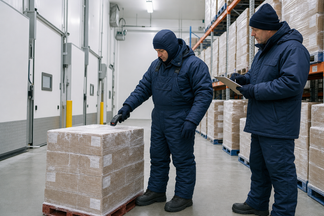
Have the worker walk, bend, kneel where the job requires it, reach overhead, rotate at the waist, and enter or exit permitted equipment. Watch for exposed wrists or lower back, binding at the knees and shoulders, loose material near controls, and closures that open during movement.
Scanner and Control Check
Ask the worker to scan representative labels, operate authorized controls, use a radio, and handle any small items required by the job. Gloves should provide the necessary warmth while preserving enough dexterity for the assigned task. If a worker must remove a glove to operate equipment, the selected glove system is not solving the complete problem.
Grip and Handling Check
Test representative dry, frosted, and damp packaging only where those conditions normally occur. Record slipping, excessive grip force, glove rotation, and whether insulation compresses while carrying cartons or using handles. When sharp edges or cutting tools are present, verify the required cut or puncture rating separately; thermal language does not establish cut protection.
Transition and Moisture Check
Observe workers moving between ambient, refrigerated, and frozen zones under normal procedures. Check for perspiration buildup, damp liners, fogging eyewear, and clothing that becomes uncomfortable after activity slows. OSHA and NIOSH identify wetness as an important cold-stress risk factor, so moisture performance belongs in the evaluation.
Use Clear Stop Conditions
A wear trial is not a challenge to see who can remain in the cold longest. Stop the trial and follow the facility's response procedure if a participant reports or displays cold-stress symptoms, loss of coordination, numbness, confusion, unusual fatigue, equipment interference, loss of required visibility, or any other unsafe condition.
OSHA recommends training workers to recognize cold stress, monitoring their physical condition, and providing frequent short breaks in warm, dry areas when appropriate. Keep dry replacement clothing available when garments or gloves can become wet. Existing work-rest schedules and supervisory controls remain in force throughout the trial.
Record Results With a Repeatable Scorecard
Use the same questions for each approved product configuration. A simple pass, concern, or fail score works better than asking whether a garment felt comfortable.
Record:
- Garment, glove, and footwear manufacturer numbers
- Sizes and layers worn
- Temperature zone and trial duration
- Mobility through required tasks
- Scanner, control, radio, and tool usability
- Grip on representative materials
- Cuff, hood, footwear, and PPE compatibility
- Moisture or fogging observations
- Pressure points, cold spots, or exposed areas
- Donning and removal time
- Worker comments
- Supervisor observations
- Corrective action or final disposition
Photographs can help document fit problems when company policy permits, but do not photograph proprietary processes, customer information, or workers without authorization.
Turn Trial Results Into a Purchasing Specification
The final decision should identify an approved configuration by job role, not merely name a winning jacket. Record the compatible jacket, bib or coverall, glove, headwear, and footwear arrangement along with sizes, alternate items, cleaning rules, inspection criteria, and replacement triggers.
A configuration may pass for a picker and fail for a technician who uses hand tools. That does not make the product defective; it means the task requirements differ. Controlled assortments are often more practical than forcing every department into one universal kit.
Before ordering, confirm current manufacturer specifications, temperature-rating language, care instructions, certifications, pack quantities, availability, and lead times. Temperature ratings should be used as comparison information, not as guarantees of comfort or safe exposure duration.
Facilities purchasing multiple sizes or configurations can review freezer and cold-storage workwear or request a formal PPE quote from ASA, LLC with roles, temperature zones, sizes, quantities, and current product information.
Keep Cryogenic Processes Outside an Ordinary Freezer-Wear Trial
Mechanical blast freezers and cryogenic processes are not interchangeable PPE scenarios. If liquid nitrogen, carbon dioxide, or another cryogenic material is used, follow the current safety data sheet, equipment instructions, ventilation and monitoring requirements, emergency procedures, and process-specific PPE documentation.
Do not use an ordinary freezer-workwear trial to evaluate protection against cryogenic splash, oxygen-deficient atmospheres, or emergency releases. Ordinary insulated gloves and garments must not be assumed to provide cryogenic protection.
Frequently Asked Questions
How long should a freezer PPE wear trial last?
Use a duration that represents an authorized work cycle without exceeding established exposure controls. The trial should evaluate normal tasks, not determine a maximum safe exposure time. Follow the facility's warm-up schedule and cold-stress procedures.
Should every employee test the PPE?
Not necessarily. Start with a representative group covering the job's normal size range and task variations. Broader fitting may still be required before final issue because PPE must fit each affected employee properly.
What should cause a freezer glove to fail the trial?
Examples include inadequate warmth for the approved work cycle, loss of grip, inability to use required controls or scanners, poor cuff integration, excessive moisture buildup, or interference with another required protection. Verify cut, puncture, impact, chemical, and food-contact requirements separately.
Can one freezer PPE configuration cover every job role?
Sometimes core garments can be standardized, but gloves, footwear, visibility features, and insulation needs often vary by role. Approve configurations according to exposure and task requirements rather than forcing one universal kit.
Does a successful wear trial prove the PPE is OSHA compliant?
No. A wear trial evaluates fit and task performance. Compliance depends on the employer's hazard assessment, required standards, product documentation, training, maintenance, and correct use.