

Jun 7th 2026
What PPE Is Needed in Foundries?
A foundry can expose workers to radiant heat, molten splash, silica dust, sharp castings, noise, and mobile equipment - often in the same shift. That is why asking what PPE is needed in foundries is really a hazard assessment question, not a simple shopping list. The right answer depends on the process, the exposure level, and whether the worker is melting, pouring, grinding, fettling, maintaining equipment, or moving material.
For safety managers and buyers, the goal is not just to issue gear. It is to match PPE to specific foundry hazards, confirm the equipment meets applicable standards, and make sure workers can perform the job without removing protection because it is too hot, too bulky, or poorly fitted.
What PPE is needed in foundries depends on the hazard
Foundries are not uniform environments. A worker at the furnace line faces a different risk profile than a maintenance technician in a cooler area or a grinder finishing cast parts. PPE selection should follow the facility hazard assessment and account for heat, impact, dust, chemical exposure, and the potential for sudden high-consequence incidents such as molten metal splash.
In most operations, core PPE categories include head protection, eye and face protection, hearing protection, hand protection, foot protection, flame-resistant or heat-resistant clothing, and respiratory protection where airborne contaminants are present. Some tasks also require metatarsal protection, leggings, spats, aprons, or task-specific aluminized garments.
The trade-off is that higher protection levels can increase heat stress and reduce dexterity. That is why foundry PPE programs work best when they are built around job task analysis, wear testing, and supervisor feedback rather than one standard kit for every role.
Head, eye, and face protection for foundry work
Head protection is basic in any foundry because of overhead hazards, material handling, and moving equipment. Hard hats should meet the appropriate ANSI requirements and be compatible with the rest of the PPE system. In higher-heat areas, buyers should pay attention to suspension performance, accessory compatibility, and whether workers need integrated face protection.
Eye and face protection deserve more attention than they often get. Safety glasses with side protection are the starting point, but they are rarely enough on their own near molten metal, cutting, chipping, or grinding. Face shields are commonly required over primary eye protection for splash, flying particles, and thermal hazards. For pouring and furnace work, heat-reflective face shields or gold-coated options may be appropriate if the hazard assessment supports them.
This is also where comfort matters. Lenses that fog up or scratch too easily tend to get pushed up or removed. In a foundry, that can turn a minor irritant into a recordable injury quickly.
When face shields are not enough
A face shield protects the face, but it does not replace safety glasses or goggles. If workers are grinding, blasting, or handling dust-producing operations, sealed or better-fitting eye protection may be needed under the shield. The exact combination depends on whether the main concern is impact, dust, chemical splash, or radiant heat.
Hand protection and protective clothing in foundries
Hand injuries in foundries come from more than heat. Workers handle hot surfaces, rough castings, sharp edges, tools, and sometimes chemicals used in molding or cleaning. Gloves need to be selected for the dominant hazard, which means one style usually does not fit every station.
For molten metal areas, gloves should provide heat resistance, wrist and forearm coverage, and a design that reduces the chance of trapping molten material. For finishing work, cut resistance may matter more than high heat resistance. In some cases, a more flexible glove improves grip and reduces hand fatigue, but it may not provide enough thermal protection for furnace-side tasks.
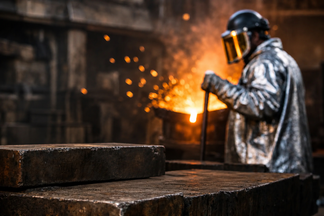
Protective clothing is equally task-specific. Foundry workers commonly need flame-resistant or heat-resistant garments that cover the torso, arms, and legs. For higher radiant heat or splash exposure, aluminized coats, jackets, aprons, leggings, and spats may be required. Buyers should look closely at closures, pocket placement, and garment design. Features that can catch molten splash or leave gaps at the neck, wrist, or boot line can create serious burn exposure.
Natural fiber underlayers are often preferred in hot work environments because some synthetic fabrics can melt under high heat. PPE policy should also address whether workers are wearing noncompliant base layers that could increase injury severity.
Foot protection is critical around molten metal
Standard safety toe boots may not be enough in a foundry. Footwear often needs heat resistance, puncture resistance, slip resistance, and protection against impact from heavy castings or tools. In many operations, metatarsal guards are necessary, whether built into the boot or worn externally.
For molten metal exposure, boot design matters as much as the rating. Foundry boots should minimize places where hot material can collect and should support fast removal in an emergency if contamination occurs. Pants should typically cover the boot tops without being tucked in, because tucked pant legs can funnel molten material directly into the boot.
This is one of the clearest examples of why generic industrial PPE can fall short. A boot that performs well in warehousing or general manufacturing may be a poor choice on a foundry floor.
Respiratory protection in dusty and fume-producing areas
If you are evaluating what PPE is needed in foundries, respiratory protection cannot be treated as optional. Sand handling, shakeout, blasting, grinding, and cleaning can generate respirable dust, including silica in some operations. Melting and pouring can also create fumes depending on the metals, binders, coatings, and additives involved.
The right respirator depends on exposure monitoring, task duration, and the contaminants present. In some areas, disposable filtering facepiece respirators may be used if they match the hazard and the respiratory protection program supports them. In other cases, half-mask or full-face elastomeric respirators with the correct cartridges and filters are more appropriate. Higher-exposure tasks may justify powered air-purifying respirators if engineering controls do not reduce exposure enough and if heat burden can be managed.
Respirator selection also brings administrative requirements. Medical evaluation, fit testing, training, maintenance, and cartridge change-out schedules are all part of the program. For buyers, that means the purchasing decision should align with the facility's ability to support ongoing compliance, not just initial unit cost.
Hearing protection and visibility on active foundry floors
Noise is a constant issue in many foundries, especially around shakeout, grinding, blasting, and material movement. Hearing protection should be selected based on measured noise levels and the need for communication. Earplugs may work well in some roles, while earmuffs or dual protection may be necessary in higher-noise zones.
At the same time, workers still need to see and be seen. In foundries with vehicle traffic, overhead cranes, and mobile handling equipment, high-visibility garments may be needed, but they must also be compatible with heat and flame exposure. This is an area where buyers should avoid assumptions. A standard high-visibility vest may improve visibility but may not be suitable near ignition or thermal hazards. The right solution depends on the work area and the hazard hierarchy.
Common mistakes when choosing foundry PPE
One frequent mistake is buying one glove, one face shield, and one garment program for the whole plant. Foundry tasks vary too much for that approach to hold up. Another is focusing on product price without accounting for wear life, replacement frequency, and the operational cost of discomfort-driven noncompliance.
A third mistake is treating PPE as the primary control. PPE is essential, but it works best with guarding, ventilation, isolation, housekeeping, training, and clear work practices. If silica dust, heat stress, or splash risk is not controlled upstream, even good PPE may not be enough.
Fit is another problem area. Oversized gloves reduce control. Poorly fitted eyewear gaps at the temples. Ill-fitting garments create snag hazards or expose skin during movement. For procurement teams, standardized purchasing should still leave room for size range, task variation, and field feedback.
Building a practical foundry PPE program
The strongest programs start with the hazard assessment, then build PPE kits by task and exposure level. That usually means separate specifications for melting and pouring crews, grinders and finishers, maintenance staff, forklift operators, and support personnel entering production zones.
It also helps to review PPE as a system rather than as isolated items. Hard hats need to work with face shields. Eyewear has to fit under shields and around respirators. Gloves need enough cuff length to overlap sleeves without limiting movement. Boots, leggings, and pants need to work together to reduce molten entry points.
For organizations managing multi-shift operations or multiple sites, consistency matters. Workers are more likely to wear PPE correctly when the equipment is familiar, available, and easy to replace. That is one reason industrial buyers often work with specialized suppliers such as ASA, LLC - not just to source products, but to narrow down compliant options that fit the actual hazards on the floor.
A good closing question for any foundry PPE review is simple: if a worker is exposed to heat, dust, impact, and motion in the same task, does the current PPE set protect against all four without creating a new problem? If the answer is not clear, the PPE program probably needs another look.