

Jun 8th 2026
Respirator Fit Testing Guide for Safer Crews
A worker can have the right respirator on paper and still be unprotected on the job. That gap usually comes down to fit. This respirator fit testing guide is built for safety managers, supervisors, and PPE buyers who need a clear process that holds up in real operations, not just during an audit.
Respirators only work when the facepiece seals correctly to the user’s face. If the seal fails, airborne contaminants can enter around the edges, even when the filter media is performing as designed. That is why fit testing is not an administrative extra. It is a core part of respiratory protection, especially in manufacturing, construction, food processing, chemical handling, maintenance, and emergency response settings where exposure risks can change quickly.
What respirator fit testing actually confirms
Fit testing checks whether a specific make, model, style, and size of tight-fitting respirator can form an effective seal on an individual worker. It does not tell you whether the respirator is the right type for the hazard. That decision belongs in the hazard assessment and respirator selection process. It also does not replace a user seal check, which workers should perform every time they put on the respirator.
That distinction matters. A crew may pass fit testing on an N95 filtering facepiece respirator for nuisance dusts or low-level particulates, but if the actual hazard requires a half-mask elastomeric respirator with the correct cartridges, the fit test alone will not solve the exposure problem. Fit is one piece of a larger respiratory protection program.
Respirator fit testing guide to OSHA basics
For US employers, respirator fit testing requirements are tied to OSHA’s respiratory protection standard. In practical terms, any employee required to wear a tight-fitting facepiece respirator must be fit tested before initial use, whenever a different respirator facepiece is used, and at least annually after that.
Additional fit testing is also needed when something changes that could affect fit. Weight fluctuations, facial scarring, dental work, reconstructive surgery, and other facial changes can all alter the seal. If a worker reports that a respirator no longer fits properly, that should trigger immediate review rather than waiting for the annual schedule.
Tight-fitting respirators include N95s, elastomeric half masks, full-face respirators, and tight-fitting powered air-purifying respirators. Loose-fitting PAPRs are different because they do not rely on a face seal in the same way, so fit testing is generally not required. That said, they bring other selection and maintenance considerations, including battery management, airflow verification, and compatibility with the work area.
Qualitative vs. quantitative fit testing
There are two accepted methods for fit testing: qualitative and quantitative. The best choice depends on the respirator type, the workplace hazard, and how much documentation precision your program needs.
Qualitative fit testing is a pass or fail method. It relies on the wearer’s ability to detect a test agent by taste, smell, or irritation. Common agents include saccharin, Bitrex, isoamyl acetate, and irritant smoke. This method is often used for disposable filtering facepiece respirators and half-mask respirators when the required fit factor is within the method’s limitations.
Quantitative fit testing uses an instrument to measure leakage into the respirator and calculate a numerical fit factor. It does not depend on the worker’s senses, which makes it more objective. This method is often preferred for full-face respirators, higher-risk tasks, and programs that want stronger documentation or more detailed troubleshooting.
Neither method is automatically better in every setting. Qualitative testing can be cost-effective and practical for large groups wearing common disposable respirators. Quantitative testing offers stronger measurement data, but equipment costs, calibration, and training requirements are higher. For many facilities, the right answer depends on exposure level, respirator type, workforce size, and how often workers change models or sizes.
Before the test: the steps that prevent bad results
A fit test is only as good as the preparation behind it. If the basics are skipped, the result can be misleading.
Medical evaluation comes first. Workers must be medically cleared to wear a respirator before fit testing. A person who is not medically able to wear a respirator should not be pushed through the process just to check a compliance box.
The worker also needs the correct respirator for the hazard. That means matching the facepiece and filter or cartridge to the exposure profile, whether the issue is particulates, fumes, mists, vapors, or a combination hazard. Procurement teams should be careful here. Standardizing too aggressively on one model may simplify ordering, but it can create fit problems across a diverse workforce.
Training matters as much as equipment selection. Before testing, employees should know how to don the respirator, position the straps, adjust the nosepiece if applicable, and perform a user seal check. A poor donning technique can cause repeated test failures that have nothing to do with the respirator design.
Facial hair is another common failure point. Tight-fitting respirators cannot seal properly over beards, stubble, or any hair that crosses the sealing surface. That rule is straightforward, but enforcement is often inconsistent. If your operation depends on tight-fitting respirators, grooming expectations need to be clear before fit test day.
How the fit testing process usually works
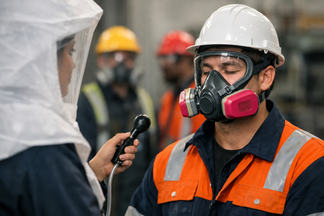
For qualitative testing, the worker first completes a sensitivity check without the respirator to confirm they can detect the test agent. Then, wearing the selected respirator, they place a hood over the head and perform a sequence of exercises while the agent is introduced. Those exercises typically include normal breathing, deep breathing, turning the head side to side, moving the head up and down, speaking, bending, and returning to normal breathing. If the worker detects the agent during the test, the respirator fails.
For quantitative testing, the respirator is connected to a measuring instrument directly or through a sampling adapter. The worker performs similar exercises while the equipment measures the concentration inside and outside the respirator. The instrument then calculates a fit factor. To pass, the respirator must achieve the required fit factor for that type of facepiece.
A failed test should not be treated like a one-time inconvenience. It is useful information. It may point to the wrong size, the wrong model, poor strap adjustment, an incompatibility with safety glasses, or a worker who needs more training on donning. In many programs, simply trying a different approved model solves the issue.
Common reasons workers fail fit tests
The most common problem is assuming one respirator will fit everyone. It will not. Different face shapes, nose bridges, jawlines, and facial dimensions affect seal quality. Stocking only one disposable model may reduce SKU count, but it can leave part of the workforce without an acceptable fit.
Eyewear and other PPE can also interfere. Safety glasses, hearing protection, face shields, and hard hats all need to work with the respirator, not against it. This is especially important in manufacturing and utility work where multiple PPE items are worn together for long periods.
Another issue is using the wrong test for the respirator or the hazard level. A basic pass or fail approach may be acceptable in some settings, but higher-risk operations may call for quantitative data and tighter control. If your facility handles hazardous particulates, chemical exposures, or tasks with elevated protection factors, your fit testing strategy should reflect that reality.
Building a fit testing program that works in the field
A usable program is consistent, documented, and realistic about workforce turnover. Annual testing should be scheduled, not improvised. New hires should be tested before exposure begins. Facilities with multiple shifts need a process that does not leave night crews or temporary labor out of compliance.
Documentation should include the employee name, test date, respirator make and model, size, test method, and result. If a worker passes only in a specific model and size, purchasing records and stockroom practices should support that exact assignment. Substituting a lookalike product during a shortage can create immediate compliance and protection issues.
This is where buyer decisions have operational consequences. A respirator program is stronger when sourcing, inventory control, and safety management are aligned. The lowest unit price is not always the lowest program cost if workers fail fit tests, burn time trying alternates, or cannot be cleared for work on schedule.
For organizations managing multiple sites, standardization should be balanced with flexibility. It helps to narrow approved respirator options, but there should still be enough variety to fit the workforce. Experienced suppliers such as ASA, LLC can help buyers compare approved options by application, style, and workforce needs without overcomplicating the program.
When to reassess your current approach
If workers frequently complain about discomfort, if annual retesting produces a high failure rate, or if supervisors are swapping models based on availability, your program likely needs review. The same applies if workers are wearing respirators in hot conditions, high-movement tasks, or mixed PPE environments where straps and face seals shift during the day.
A fit test is a point-in-time measurement. Real work adds sweat, motion, temperature changes, communication demands, and long wear periods. That does not make fit testing less valuable. It means the best programs treat it as part of ongoing respirator management, not the finish line.
The strongest respiratory protection programs are the ones that respect small details before they become exposure events. When fit testing is handled with that mindset, it does more than satisfy OSHA. It helps keep the right people in the right protection so the job keeps moving safely.