

Jul 7th 2026
NFPA 70E Explained for Safety Managers
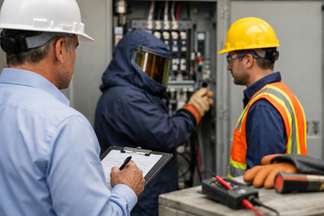
A technician opens a panel for what looks like a routine task, and suddenly the conversation shifts from maintenance to emergency response. That is why NFPA 70E matters. For safety managers, plant supervisors, and PPE buyers, nfpa 70e is not just a document to reference during training. It is a working standard that shapes how electrical jobs are planned, how hazards are labeled, and how protective equipment is selected before someone is exposed to shock or arc flash.
What NFPA 70E actually covers
NFPA 70E is the Standard for Electrical Safety in the Workplace. Its purpose is straightforward - reduce exposure to major electrical hazards during work activities such as installation, inspection, operation, maintenance, and demolition of electric conductors and equipment.
In practical terms, the standard helps employers build an electrical safety program that accounts for shock risk, arc flash risk, energized work practices, condition of maintenance, and PPE requirements. It is often discussed alongside OSHA because OSHA requires employers to protect workers from recognized hazards, while NFPA 70E gives a widely accepted framework for doing that in electrical environments.
That distinction matters. OSHA can cite an employer for unsafe electrical work, but NFPA 70E gives the detailed methods many organizations use to show they took reasonable steps to identify hazards, train workers, and provide proper protection.
Why NFPA 70E matters beyond compliance
For most facilities, electrical risk is not limited to electricians. Maintenance teams, automation technicians, HVAC staff, controls specialists, contracted service crews, and some production employees may all work near energized equipment. In facilities with robotics, automated assembly systems, motor controls, or predictive maintenance programs, more people may be interacting with electrical systems than the org chart suggests.
The real value of NFPA 70E is that it forces decisions before exposure happens. It asks whether equipment can be placed in an electrically safe work condition. It requires employers to think through boundaries, incident energy, tools, clothing systems, and work methods. That planning reduces injuries, but it also reduces downtime, investigation costs, and the operational disruption that follows an electrical event.
For procurement teams, this is where standards and purchasing meet. Buying general PPE is not the same as buying electrical hazard PPE. Arc-rated clothing, voltage-rated gloves, face shields, balaclavas, hard hats, and eye protection must align with the hazard assessment and task. If the wrong gear is ordered, crews either delay work or proceed with inadequate protection. Neither outcome is acceptable.
NFPA 70E and PPE selection
One of the most common points of confusion in NFPA 70E is PPE selection. Buyers often assume a higher rating is always better, but that is only partly true. Over-specifying can increase cost, reduce comfort, and make compliance harder if workers resist heavier or hotter gear. Under-specifying creates obvious exposure problems.
The standard ties PPE to the actual hazard. That means first identifying whether the concern is shock, arc flash, or both. Shock protection involves approach boundaries and insulated tools and gloves. Arc flash protection focuses on incident energy exposure and arc-rated garments and face protection.
Arc-rated clothing is not just "flame resistant"
NFPA 70E uses arc-rated PPE for arc flash exposure because arc flash events involve thermal energy. A garment can be flame resistant and still not provide the arc rating needed for a given task. That is why product labeling and documentation matter so much in purchasing.
For example, if a task exposes a worker to a calculated incident energy level, the clothing system must meet or exceed that level. Shirt, pants, coveralls, outerwear, and face protection may all be part of the system. In some environments, layering may help achieve the needed rating, but that only works if the system has been properly evaluated.
Rubber insulating gloves solve a different problem
Another frequent mistake is treating all electrical PPE as if it covers the same hazard. Voltage-rated rubber insulating gloves are selected for shock protection, not arc flash protection alone. They often need leather protectors, regular testing, inspection protocols, and storage controls to stay serviceable.
For mixed tasks, workers may need both shock and arc flash protection at the same time. That affects what purchasing teams stock and how kits are built for maintenance personnel or contractors.
The role of the risk assessment
NFPA 70E is built around risk assessment, not guesswork. The standard asks employers to identify hazards, estimate severity and likelihood, and then apply risk control methods. PPE is part of that process, but it is not the first step.
The preferred approach is to eliminate the hazard where possible by establishing an electrically safe work condition. If equipment can be de-energized, locked out, verified, and grounded where required, the risk profile changes dramatically. If energized work is justified, then the organization needs documented procedures, appropriate boundaries, qualified workers, and PPE matched to the task.
This is one of the biggest trade-offs in real operations. Production pressure may push teams toward working energized to avoid downtime. NFPA 70E pushes back on that mindset by requiring justification and structure. In many cases, the safer choice is also the more disciplined operational choice, even if it means a scheduled outage.
Labels, studies, and real-world limitations
Many facilities rely on equipment labels to guide arc flash PPE selection. That can work well, but only if labels are based on current and accurate data. If the electrical system changes and the study is not updated, labels can become misleading.
A strong NFPA 70E program does not stop at applying stickers to equipment. It depends on the quality of the arc flash study, the condition of maintenance, and the ability of workers to interpret what they are seeing in the field. Old equipment, undocumented modifications, or inconsistent maintenance can all affect real hazard levels.
That is why safety managers should treat labels as part of the system, not the whole system. Training, maintenance records, energized work controls, and PPE availability all have to line up.
Training under NFPA 70E
Training is where many programs either become usable or remain theoretical. NFPA 70E expects employees exposed to electrical hazards to understand the risks relevant to their work. Qualified persons need deeper training tied to the construction and operation of equipment and the methods used to reduce risk.
For supervisors, one challenge is making sure training matches actual tasks. A general electrical safety course does not automatically prepare a worker to troubleshoot energized motor control equipment, interact with switchgear, or test live circuits. The more specific the task, the more specific the training should be.
Refresher training also matters when work practices change, new equipment is introduced, or audits show employees are drifting from procedure. A written program that is not reinforced on the floor will not hold up well under pressure.
Buying PPE for an NFPA 70E program
From a purchasing standpoint, electrical PPE should be treated as a controlled category, not a general consumable. The goal is not simply to buy approved items. The goal is to buy equipment that matches the facility's hazard assessments, task exposures, workforce roles, and replacement cycles.
That usually means standardizing core products where possible while allowing for role-specific variations. Maintenance electricians may need one set of arc-rated daily wear, while troubleshooting teams, contractors, or high-exposure personnel may require additional layered systems, gloves, hoods, and face protection. Storage, inspection, laundering guidance, and replacement intervals should also be considered before placing large orders.
This is where working with a knowledgeable supplier helps. Since 2003, ASA, LLC has supported serious industrial buyers who need PPE aligned with standards, work conditions, and bulk purchasing realities, not just product availability.
Common mistakes safety teams should avoid
The biggest mistakes around NFPA 70E are usually not dramatic. They are routine gaps that build over time. PPE gets purchased without reviewing the task exposure. Arc-rated clothing is stocked, but glove testing is inconsistent. Labels stay in place after electrical modifications. Unqualified personnel are allowed too close to energized work. Contractors follow different rules than employees.
Most of these failures come from treating electrical safety as a narrow compliance item instead of a facility-wide operational control. NFPA 70E works best when engineering, safety, maintenance, and purchasing all share the same assumptions about risk and protection.
What good implementation looks like
A good NFPA 70E program is visible in everyday decisions. Equipment is de-energized whenever practical. Job planning addresses boundaries and PPE before the task starts. Workers know when they are qualified for a task and when they are not. Electrical PPE is available, in good condition, and specific to the exposure. Labels, studies, and procedures are reviewed when system changes occur.
Just as important, management understands that electrical safety is not a paperwork exercise. It is a discipline that protects people and keeps operations stable. The facilities that handle it well are usually the ones that treat standards as operating requirements, not shelf documents.
If you are responsible for worker protection, the best next step is often simple: compare your actual tasks, actual equipment, and actual PPE inventory against what NFPA 70E expects. The gaps you find there are usually more useful than any training slide deck.