

May 28th 2026
Manufacturing Safety Glasses Options That Fit
A scratched lens, constant fogging, or poor side coverage can turn eye protection into a daily complaint - and a real exposure. When buyers compare manufacturing safety glasses options, the right choice usually comes down to one question: what hazards are actually present at the task level, not just on the department chart.
How to evaluate manufacturing safety glasses options
In manufacturing environments, safety eyewear is rarely one-size-fits-all. A sheet metal operation, a food packaging line, a robotic assembly cell, and a pharmaceutical production area may all require eye protection, but the hazard profile is different in each setting. That is why selection should start with the work itself: impact risk, dust load, chemical splash potential, lighting conditions, temperature swings, and whether workers need all-day wear or task-specific protection.
For most general industrial applications, the baseline requirement is ANSI/ISEA-compliant impact-rated eyewear. That is the starting point, not the finish line. Compliance matters, but so does matching the product to real operating conditions. A pair of glasses that meets the standard but fogs up in a humid facility or slips under a hard hat and hearing protection stack will not perform well for long.
Safety managers and procurement teams usually get better results when they treat eyewear as a category with several use cases rather than a single SKU for the whole plant. Standardization can simplify purchasing, but over-standardization can create wearability problems that lead to non-use, breakage, and frequent replacement.
The main categories of manufacturing safety glasses options
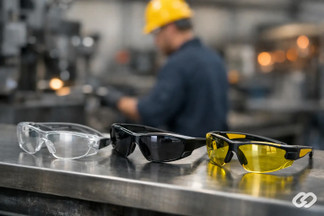
The broadest category is general-purpose safety glasses. These are commonly used for machining, material handling, assembly, warehousing, packaging, and maintenance where the primary risk is flying particles or incidental impact. They are usually lightweight, easy to issue at scale, and available with clear, indoor/outdoor, or tinted lenses.
Then there are foam-lined or gasketed safety glasses. These are useful where dust, fine particulates, or wind exposure are more serious concerns. They can provide a more secure barrier around the eye than open-frame styles, but there is a trade-off. More sealing around the face can also increase heat buildup and fogging if the venting and lens coating are not well matched to the environment.
In operations with splash hazards, standard glasses may not be enough. Chemical handling, sanitation processes, parts washing, and some food processing applications may call for goggles instead of glasses, or goggles worn over prescription eyewear. This is one of the most common selection mistakes in mixed-use facilities: issuing impact glasses where splash protection is the actual need.
Face shields also come into the conversation, but they are not a substitute for primary eye protection in most industrial settings. If the task requires safety glasses plus a face shield, both need to be specified. Buyers trying to simplify SKUs should be careful not to reduce the protection level by replacing one with the other.
Lens material and impact performance
Most manufacturing safety eyewear uses polycarbonate lenses because they combine impact resistance with low weight. That makes sense for the majority of industrial use cases. Polycarbonate also supports wraparound designs that improve side protection and field of vision.
There are situations where lens durability becomes a bigger issue than basic impact resistance. In abrasive environments, workers may scratch lenses quickly, which affects visibility and drives replacement cost. Hard-coat treatments can help, but they are not all equal. A lower-cost pair may check the compliance box and still fail early if the coating does not hold up to repeated cleaning, dirty glove handling, or dusty storage conditions.
Lens color and visibility on the floor
Clear lenses are the default for indoor manufacturing, especially in controlled lighting. But not every indoor environment is evenly lit. Facilities with bright dock doors, skylights, welding zones nearby, or mixed indoor/outdoor movement may benefit from indoor/outdoor lenses that reduce glare without overly darkening the view.
Gray or smoke lenses can work for outdoor yard work, loading, and utility support around manufacturing sites, but they are usually not ideal inside the plant. In low-light production areas, darker lenses can reduce visual accuracy and increase worker resistance to wearing them. The right tint depends on the lighting, not just the location.
Fit is not a comfort issue alone
Poor fit creates protection gaps. If glasses slide down the nose, sit too far from the face, interfere with respirators, or leave wide side openings, they may meet the standard and still underperform in the field. For buyers outfitting teams across multiple shifts, fit range matters.
Look for adjustable temples, flexible nose pieces, and frame designs that work with other PPE. This is especially relevant in plants where workers are wearing bump caps or hard hats, earmuffs, and disposable or half-mask respirators. Safety glasses need to function as part of a PPE system, not as a stand-alone product.
For high-turnover environments, universal fit models may seem practical, but they often create a false economy. If workers reject them, replacements and exceptions start piling up. Many facilities do better with two or three approved frame styles instead of one mandatory model for every employee.
Prescription and over-the-glass needs
A large share of manufacturing employees require vision correction, and this is where many eyewear programs break down. Standard safety glasses worn over regular prescription eyewear can be acceptable in some cases, but they tend to be bulkier and less comfortable for all-day use.
If employees wear corrective lenses full time, prescription safety eyewear programs usually produce better compliance and better visual performance. Over-the-glass models still have a place for visitors, temporary workers, short-term assignments, and contractor management, but they are rarely the best long-shift solution for core production staff.
Coatings often decide whether glasses stay on the worker
Anti-fog coating is one of the most valuable upgrades in manufacturing safety glasses options, especially in humid plants, washdown zones, food processing areas, and facilities with temperature transitions. A lens that fogs when a worker moves from cooler storage into warmer production space creates both a safety issue and an adoption issue.
That said, anti-fog performance varies significantly. Some coatings handle light condensation but fail under repeated temperature swings. Others hold up better but require more careful cleaning. If your team works in cold storage support, loading transitions, or high-humidity packaging, the coating specification deserves the same attention as the frame style.
Anti-scratch coating is just as important in dirty industrial environments. Without it, lenses may become unusable long before the frame wears out. For procurement teams, this is not a minor feature. Better coatings can reduce replacement frequency and support a lower total cost per worker over time.
Matching eyewear to the manufacturing hazard
The best selection process usually starts by grouping tasks, not departments. A maintenance tech cutting conduit, an operator loading resin, and a packer on an automated line all work in manufacturing, but their eye hazards are not the same.
Impact-heavy areas such as machining, grinding support, fabrication, and material cutting generally need high-wrap, impact-rated eyewear with good side coverage and durable coatings. Dust-prone environments often benefit from foam-lined styles, as long as fog control is adequate. Chemical exposure points may require sealed eyewear or goggles. Clean manufacturing and pharmaceutical operations may prioritize optical clarity, compatibility with masks, and easy sanitation.
Facilities using robotics and automated systems should also think about the less obvious risk zones. Workers entering cells for maintenance, clearing jams, or handling parts near moving equipment can be exposed to sudden debris or fragments even if the normal production task appears low risk.
What buyers should look for before standardizing
Before committing to a plant-wide eyewear program, test a short list in actual conditions. A controlled trial across roles and shifts usually reveals more than a spec sheet. Ask whether lenses fog during the first two hours, whether temples interfere with hearing protection, whether workers remove the glasses to read labels, and how quickly scratches appear.
It also helps to review replacement patterns. If one facility is burning through eyewear twice as fast as another, the issue may not be worker carelessness. It could be the wrong coating, poor storage, bad fit, or an unrecognized exposure that calls for a different style.
For multi-site buyers, consistency still matters. The goal is not endless customization. It is a controlled product selection built around actual hazards, compliance requirements, and wearability. That approach supports safety performance and purchasing efficiency at the same time.
ASA, LLC has worked with industrial buyers since 2003, and the pattern is consistent: when eyewear is selected by task, environment, and compatibility with the rest of the PPE program, crews wear it more consistently and operations spend less time solving preventable issues.
The right safety glasses are rarely the cheapest pair on the shelf or the most feature-heavy model in the catalog. They are the pair your team can wear for the full shift, in the real environment, with the right level of protection and no daily workarounds.