

Jul 13th 2026
Industry 5.0 and Safety Regulations at Work
A collaborative robot can slow down when a worker enters its zone, but that feature alone does not make the operation safe. A sensor can detect a temperature spike in a freezer compressor, but it does not replace insulated gloves, safe maintenance procedures, or a trained technician. Industry 5.0 and safety regulations meet at this practical point: technology can improve protection, but employers remain responsible for controlling hazards at the job level.
For safety managers, plant leaders, and procurement teams, the question is not whether to adopt robotics, connected equipment, predictive maintenance, or digital work instructions. The question is how to introduce them without creating new exposure paths, weak points in compliance, or confusion on the floor.
What Industry 5.0 Means for Workplace Safety
Industry 5.0 builds on automation and data-driven manufacturing while putting people, resilience, and sustainability back at the center of operations. In a working facility, that can mean collaborative robots working near employees, IoT sensors monitoring equipment conditions, wearable devices, automated guided vehicles, digital twins, and AI-supported maintenance planning.
This human-centered focus can reduce risk when it is designed well. Predictive maintenance may identify vibration, heat, pressure, or battery issues before equipment fails. Automated material handling can limit repetitive lifting. Connected environmental monitoring can warn supervisors about hazardous temperatures, air quality changes, or chemical process deviations.
The trade-off is that every connected system changes the risk assessment. A robot may remove one manual task while introducing pinch points, unexpected movement, stored-energy hazards, or line-of-sight problems. An automated process may improve consistency but leave workers less familiar with how to respond when the system faults. Technology changes the hazard profile. It does not eliminate it.
Industry 5.0 and Safety Regulations: What Still Applies
Industry 5.0 is an operational model, not a separate OSHA regulation. Existing federal, state, and industry requirements still apply to the work being performed, the equipment in use, and the hazards present.
For most industrial facilities, the foundation includes OSHA requirements for machine guarding, lockout/tagout, electrical safety, hazard communication, walking-working surfaces, respiratory protection, and personal protective equipment. OSHA's General Duty Clause may also be relevant when a recognized serious hazard is not addressed by a specific standard. Where chemical processes, confined spaces, forklifts, fall exposures, or high-noise operations are involved, additional requirements may apply.
Consensus standards also matter. Robot and automation suppliers commonly design around ANSI, RIA, ISO, NFPA, and other applicable standards, but a manufacturer statement should not replace the employer's own site-specific evaluation. The final installation may have different tooling, layouts, materials, speeds, operators, maintenance practices, and adjacent traffic than the original equipment design anticipated.
A safety manager should treat regulatory compliance as the minimum operating floor, then use the risk assessment to determine whether additional engineered controls, administrative controls, training, or PPE are needed.
Cobots Are Not Automatically Low Risk
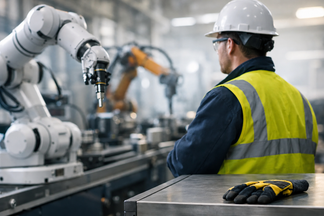
Collaborative robots are often described as safer because they can work in shared spaces. That description can be incomplete. The robot's arm may be force-limited, but the end effector, workpiece, fixture, conveyor, or nearby machine may still create crushing, cutting, puncture, entanglement, or ejection hazards.
A sheet metal part handled by a cobot can have sharp edges. A glass panel can break. A palletizing cell can create overhead and struck-by exposure. A cobot performing adhesive dispensing may introduce chemical contact or ventilation concerns. The risk assessment must consider the complete application, not just the robot model.
Safety functions such as presence sensing, speed and separation monitoring, emergency stops, safeguarding, and restricted spaces need validation after installation and after any meaningful change. That includes a new gripper, altered speed setting, revised product size, software update, or layout adjustment.
Lockout/Tagout Becomes More Complex, Not Less Necessary
Connected equipment can have more energy sources than conventional machinery. Electrical, pneumatic, hydraulic, thermal, gravity, spring tension, stored pressure, battery power, and remote-start capability all need consideration. Automated systems can also receive commands from a network, control room, or integrated upstream process.
A compliant lockout/tagout procedure must identify every relevant energy source and establish how it will be isolated, locked, released, or restrained before servicing begins. Verify zero-energy conditions before work starts. Do not assume a stopped machine is de-energized, and do not treat an emergency stop as an energy-isolating device.
This is especially important in cold storage and food processing environments, where defrost systems, conveyors, refrigeration equipment, automated doors, and powered racking systems may interact. Freezer-rated outerwear and thermal gloves can help protect workers from cold stress, but they must not interfere with dexterity, visibility, communication, or access to emergency controls.
Build the Risk Assessment Around Real Work
The most useful assessment follows the worker through the actual task, including normal production, product changeovers, cleaning, jams, calibration, troubleshooting, and maintenance. Observing only the automated cycle misses the moments where people are most likely to bypass a guard, reach into a hazardous area, or work under time pressure.
Start by documenting the task, the people who perform it, energy sources, material hazards, foreseeable misuse, and emergency response needs. Then determine the controls using the hierarchy of controls. Elimination and substitution are strongest. Engineering controls such as guarding, interlocks, light curtains, ventilation, barriers, and ergonomic fixtures come next. Procedures, signage, training, and supervision support the system. PPE remains essential when residual hazards cannot be removed, but it should not be the first or only answer.
Review the assessment when the process changes. In an Industry 5.0 setting, changes happen more often than many facilities expect. A software patch, sensor replacement, AI scheduling adjustment, production mix change, or new contractor can alter how workers interact with equipment.
PPE Must Match the New Task, Not the Old Job Title
Automation can create jobs with mixed exposures. One employee may monitor a robotic cell, clear minor faults, handle sharp finished parts, perform quality checks, and enter a refrigerated staging area in the same shift. Issuing PPE based only on a broad title such as "operator" may leave gaps.
Match protective equipment to the actual exposure and the performance requirements of the task. That may include safety eyewear for flying particles, cut-resistant gloves for sharp materials, high-visibility apparel around mobile equipment, hearing protection in high-noise zones, and chemical-resistant clothing or gloves for sanitation and process chemicals. For freezer work, choose insulated garments and thermal hand protection rated for the temperature, duration, activity level, and moisture conditions involved.
Compatibility matters. Safety glasses must work with respirators and hearing protection. Gloves must provide enough grip and dexterity to operate controls safely. High-visibility garments should remain visible without catching on moving equipment. Loose sleeves, damaged gloves, jewelry, and oversized cold-weather layers can create entanglement concerns near rotating or moving machinery.
Procurement teams can reduce inconsistent protection by standardizing approved PPE by task and hazard category. Keep product specifications, certification information, sizing options, replacement intervals, and site distribution requirements documented. This is particularly valuable for multi-site operations and contractors who move between facilities.
Use Connected Safety Data Without Creating Blind Spots
IoT sensors, machine data, and digital twins can give safety teams earlier warning of abnormal conditions. Trends in motor temperature, vibration, air quality, refrigeration performance, equipment access, or near-miss activity can support preventive action before an incident or shutdown occurs.
However, data quality matters. A poorly positioned sensor, missed calibration, incomplete integration, or alarm overload can create false confidence. Every alert needs an owner, an escalation path, and a documented response expectation. If workers receive frequent non-actionable alarms, they may begin ignoring the one alarm that matters.
Connected systems also require access controls and change management. Limit who can modify safety-related settings, maintain records of changes, and ensure workers know what to do if a sensor, network, or automated safety function fails. A digital twin is valuable for planning, but it is still a model. It should inform field verification, not replace it.
Training Must Cover Decision-Making
Training in automated environments should go beyond telling workers which button to press. Employees need to understand restricted zones, guard functions, emergency-stop limitations, lockout/tagout responsibilities, alarm meanings, reporting expectations, and the situations that require them to stop work.
Make training specific to the equipment and role. Operators, maintenance personnel, sanitation crews, temporary employees, and contractors may face different hazards around the same system. Provide hands-on verification, refresher training after changes, and clear shift handoffs. For multilingual workforces, use language and visual formats workers can understand.
ASA, LLC supports this task-based approach with industrial PPE and freezer wear selected for demanding environments where compliance, product performance, and reliable replenishment all affect uptime.
The safest Industry 5.0 program is not the one with the most sensors or the newest robot. It is the one where engineering, maintenance, operations, safety, and purchasing agree on a simple standard: when the work changes, reassess the hazard, verify the controls, and put the right protection in the worker's hands before the shift begins.