

Posted by American Safety Associates, LLC on Aug 7th 2026
ANSI Safety Vest Classes: How to Choose Type and Class
A vest labeled “ANSI” is not automatically the right choice for the job. The real decision is whether the garment matches the worker’s exposure to traffic, equipment, background clutter, low light, weather, and body motion. If you are comparing ANSI safety vest classes, start with the hazard, not the color.
For most safety managers and PPE buyers, the practical question is not whether a crew needs hi-vis apparel. It is which type and class gives that crew the right level of visibility without creating heat, mobility, or layering problems. That decision affects compliance, comfort, and whether workers stay visible when conditions change.
What ANSI safety vest classes actually mean
High-visibility apparel in the U.S. is governed by ANSI/ISEA 107. OSHA guidance makes clear that employers should base PPE selection on hazard assessment, not assumptions. In work zones and other struck-by-risk environments, the needed class depends on factors such as traffic speed, work background, time of day, weather, sight distance, and how much attention the worker must divert to the job.
In practical terms, higher classes provide more visible material and stronger recognition in more demanding conditions. OSHA’s work-zone guidance states that Class 3 garments offer the greatest level of visibility, while Class 2 is appropriate for many operations where workers are close to traffic or equipment and vehicles may be moving at 25 mph or more. Class 1 provides the minimum amount of visible material and fits only lower-risk conditions.
For buyers, that means Class 2 and Class 3 should not be treated as interchangeable. The difference matters when crews work near faster traffic, reduced sight distance, poor weather, heavier task loads, or visually complex jobsites.
Type R vs. Type P matters too
Many buyers still think only in terms of Class 2 and Class 3. That is incomplete.
FHWA’s June 1, 2016 interpretation explains that ANSI/ISEA 107-2015 combined earlier roadway and public-safety garment requirements into one standard with use-based designations. Type R garments are intended for roadway workers who are exposed to traffic. Type R Class 2 and Type R Class 3 align with the older roadway classes. Type P garments are intended for public safety use and follow different design expectations for those roles.
So the label on the vest is doing two jobs:
Typeidentifies the intended use setting.Classidentifies the amount of visible coverage.
If your crew works in roadway rights-of-way, temporary traffic control zones, roadside utilities, paving, striping, surveying, or public works traffic exposure, Type R should usually be the starting point.
When Class 2 is usually the right choice
Class 2 is a common fit when workers need strong visibility but do not need the highest garment coverage available.
Typical examples include:
- Warehouse yards with forklift and truck movement
- Utility and telecom field work near traffic
- Municipal maintenance crews
- Survey crews
- Delivery yards and loading areas
- Construction work where strong visibility is needed but sleeve coverage is not always required
For these jobs, a Class 2 vest is often the practical baseline because it balances visibility, comfort, and easy layering. Buyers standardizing for these environments should start with ANSI Type R Class 2 Safety Vests.
When Class 3 is the better decision
Class 3 should be considered when visibility risk is higher and workers need to be recognized through a fuller range of body motion and from greater distance.
That usually points to:
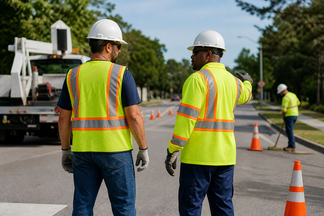
- Road crews and flaggers
- Highway contractors
- Utility crews working before sunrise, at dusk, or in poor weather
- Municipal departments working near faster-moving traffic
- Jobs where workers bend, twist, signal, or carry loads that can reduce the visible profile of a basic vest
For these conditions, ANSI Type R Class 3 Safety Vests and Safety Shirts are often the stronger destination pages because they support more visible coverage and better recognition in motion.
A vest alone does not solve every visibility problem
One of the most common purchasing mistakes is assuming the vest is the whole visibility program. It is not.
Real-world visibility depends on how the garment is used. Tool belts, rainwear, cold-weather layers, equipment cabs, body position, and carried materials can all reduce how much of the garment remains visible. That is where supporting garments and accessories matter.
Examples include:
- A Class 2 vest that is partially blocked by carried equipment
- A crew that needs more arm visibility than a vest alone can provide
- Workers whose lower-body motion matters for recognition in low light
- Jobs where gloves, headwear, or other add-ons help complete the visibility profile
For buyers building a complete visibility kit instead of buying one vest at a time, Hi-Vis Accessories is the logical supporting resource.
High-visibility apparel is still only one part of PPE selection
Hi-vis gear does not replace head, eye, hand, foot, or weather-related protection. OSHA’s work-zone guidance also points employers toward hard hats, eye protection, gloves selected for the task, protective footwear, and other PPE as needed.
That matters because the right vest class still has to work with the rest of the PPE system. A garment that overheats workers, fits poorly over layers, blocks access to other gear, or gets removed halfway through the shift is not solving the visibility problem.
How buyers should choose the right ANSI safety vest class
A practical buying process looks like this:
- Identify where workers are exposed to traffic, mobile equipment, or both.
- Confirm whether the job is roadway-facing, public-safety-facing, or general industrial use.
- Review vehicle speed, sight distance, lighting, weather, and background clutter.
- Decide whether body motion or task load means more visible coverage is needed.
- Check whether the garment must layer over rainwear, cold-weather clothing, or other site PPE.
- Standardize by exposure group rather than issuing one vest to every worker.
For mixed crews, one vest program rarely fits everyone well. Matching the garment to the actual exposure is usually the safer and more durable buying decision.
Direct answer
If you are trying to choose between ANSI safety vest classes, Class 2 is often the baseline for workers exposed to traffic or equipment in active industrial and roadway-adjacent settings, while Class 3 is the stronger choice where speeds, sight distance, task load, or visibility risk are higher. Type R is generally the correct path for roadway-exposed workers, while Type P is intended for public-safety use.
ASA, LLC supports contractors, municipalities, utilities, and industrial teams with bulk PPE sourcing and recurring safety supply support through Commercial & Government Accounts.
FAQ
Q: What is the difference between ANSI Class 2 and Class 3 safety vests?
A: Class 3 garments provide more visible coverage than Class 2 and are better suited to higher-speed traffic, reduced sight distance, or jobs where body motion and task load make workers harder to recognize.
Q: When should a buyer choose Type R hi-vis apparel?
A: Type R is generally the correct choice for roadway workers and crews exposed to traffic in rights-of-way, temporary traffic control zones, and similar roadside environments.
Q: Is a Class 2 vest enough for road work?
A: Sometimes, but not always. It depends on traffic speed, weather, sight distance, work background, and task demands. OSHA guidance points employers back to hazard assessment rather than one universal rule.
Q: Does a high-visibility vest replace other PPE?
A: No. Hi-vis apparel supports visibility, but workers may still need hard hats, eye protection, gloves, footwear, rainwear, or other PPE based on the task and environment.
Q: Can accessories improve a hi-vis program?
A: Yes. Accessories can help when the base garment is partially obstructed or when crews need a more complete visible profile across arms, legs, or headwear.