

Jun 13th 2026
Tunnels, Trenchless Technology PPE Safety
A crew can be doing everything right on paper and still get exposed underground. The reason is simple - tunnel and trenchless work changes fast. Air quality shifts, water shows up where it was not expected, access points tighten, and a routine pullback or bore can turn into a confined-space problem in minutes. That is why tunnels, trenchless technology and underground infrastructure PPE safety has to be built around the actual hazard profile of the work, not a generic PPE checklist.
For safety managers and procurement teams, the challenge is not just buying protective gear. It is matching protection to excavation methods, site conditions, utility risk, worker mobility, weather, visibility, and compliance requirements without slowing the job down. Underground work punishes poor selection decisions quickly.
Why tunnels, trenchless technology and underground infrastructure PPE safety is different
Open excavation exposes hazards in plain sight. Underground and trenchless work does not. Many risks are partially hidden by soil, structure, equipment configuration, depth, or access limitations. Crews may move between launch pits, shafts, pipe interiors, boring equipment, and surface support zones in the same shift, and each area can carry a different PPE requirement.
A horizontal directional drilling crew, for example, deals with rotating equipment, drilling fluids, traffic exposure, pinch points, and wet footing. A cured-in-place pipe rehabilitation team may face chemical exposure, splash hazards, respiratory concerns, and confined work areas. Tunnel crews may add overhead strike hazards, dust, noise, low-light conditions, and emergency egress challenges. The PPE program has to account for those differences instead of treating underground infrastructure as one hazard category.
This is where many buyers run into trade-offs. Heavier gear may improve durability but reduce mobility in tight spaces. Higher cut resistance may be necessary for handling cable, rebar, steel, or damaged pipe, but glove bulk can affect dexterity during rigging or inspection work. Better splash protection may increase heat stress in warm conditions. The right answer depends on the task, not the label on the carton.
Core PPE categories for underground infrastructure work
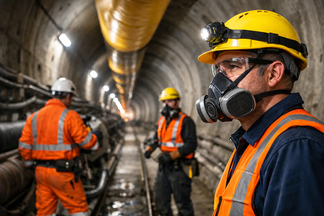
Head protection remains foundational, but not every hard hat setup works equally well below grade. Crews in tunnels and shafts often need head protection that integrates cleanly with eye protection, hearing protection, and lighting. If workers are climbing, crawling, or working around overhead obstructions, helmet stability matters as much as impact rating.
High-visibility apparel also needs closer attention than many buyers expect. Surface crews near roads, spoil removal areas, and moving equipment need ANSI-compliant visibility. In tunnels or low-light launch areas, visibility still matters, but garments also have to hold up against abrasion, mud, and restricted movement. A vest that catches on equipment or tears after a few shifts is not helping compliance or productivity.
Hand protection is where underground work often becomes very task specific. General-purpose gloves rarely cover the full range of hazards in trenchless and tunnel operations. Crews may need one glove for rigging and material handling, another for wet work, and another for chemical contact or slurry exposure. Safety managers who standardize too aggressively can end up with lower actual protection because workers start working around the glove instead of with it.
Eye and face protection should be selected with splash, debris, dust, and fogging in mind. Underground environments commonly combine moisture and temperature shifts, which can turn decent eyewear into useless eyewear if it fogs under real work conditions. Face shields may be needed for cutting, grinding, or fluid exposure, but they should complement safety eyewear rather than replace it.
Footwear has to do more than meet basic toe protection requirements. Slip resistance, puncture resistance, ankle support, and sole performance in wet clay, slurry, loose aggregate, and uneven access points all matter. Waterproofing helps in many applications, but there are jobs where breathability and drying time are just as important because saturation can become a comfort and hygiene issue over long shifts.
Respiratory protection depends heavily on the work method and site assessment. Dust, silica, exhaust, chemical vapors, oxygen-deficient atmospheres, and process-generated contaminants each call for a different response. This is an area where assumptions are costly. If the hazard is not clearly identified, the respirator choice can easily be wrong.
Matching PPE to trenchless methods
Not all trenchless technology creates the same exposure pattern. Horizontal directional drilling often centers on mud, rotating components, pressurized systems, and active surface equipment. PPE selection should emphasize eye protection for splash and debris, gloves that balance grip with abrasion resistance, high-visibility garments for equipment zones, and footwear that remains stable in wet ground conditions.
Pipe bursting and sliplining can increase pinch-point and struck-by hazards around pulling equipment and staging areas. That tends to shift focus toward durable hand protection, high-visibility clothing that does not interfere with movement, and head and eye protection that stay secure during active material handling.
CIPP and rehabilitation work may introduce resin systems, curing operations, vapors, and more direct splash potential. In those environments, chemical-resistant gloves, eye and face protection, and clothing selected for incidental chemical exposure become more relevant. Depending on the resin and process, respiratory protection and ventilation planning may also become central.
Microtunneling and conventional tunneling can combine many of the above with added concerns around confined access, low light, noise, falling or rolling material, and emergency response limitations. Buyers should think less in terms of a single PPE package and more in terms of layered protection by task zone.
Compliance matters, but usability decides whether PPE works
OSHA alignment and applicable ANSI or ISEA standards are the starting point, not the finish line. A compliant item that workers remove, modify, or avoid because it is uncomfortable or impractical creates a safety problem and an enforcement problem. For underground crews, usability usually comes down to fit, compatibility, heat load, visibility, and movement.
This is especially true when crews wear multiple forms of protection at once. A hard hat that interferes with hearing protection, eyewear that fogs under a face shield, or gloves that cannot handle wet couplings are all common failure points. Procurement teams get better results when they evaluate PPE systems, not isolated products.
Wear life should also be part of the compliance discussion. Underground work is rough on fabric, coatings, lenses, and glove palms. If gear degrades too quickly, replacement cycles become inconsistent and crews start stretching product life beyond safe use. That creates hidden risk and makes budgeting less predictable.
What safety managers should ask before ordering
The most useful purchasing questions are operational. What exactly are workers touching, breathing, climbing over, and getting splashed by? How often are they transitioning between below-grade and surface tasks? Is the job in summer heat, winter rain, or cold, wet overnight conditions? Are there traffic exposures near the pit or shaft? Is there a need for FR, chemical resistance, cut resistance, or enhanced visibility?
It also helps to ask where previous PPE programs have failed. If gloves are wearing out too fast, the issue may be material selection. If vests are not being worn, the problem may be snagging or heat. If eyewear compliance is poor, fogging or poor fit may be the real issue. These details matter more than broad product categories.
For multi-site contractors and municipal buyers, standardization still matters, but it should happen intelligently. Standardize where hazards are consistent, then allow for site-specific substitutions where conditions change. That approach supports training, stocking, and purchasing efficiency without forcing one product into every scenario.
Building a PPE program that holds up underground
The strongest programs treat PPE as one layer in a broader hazard-control plan. Underground infrastructure work still depends on traffic control, atmospheric monitoring, ventilation, lockout procedures, communication, lighting, fall protection, and emergency planning. PPE is not a substitute for those controls, but it is often the last barrier when conditions shift unexpectedly.
A practical program usually performs better than an overbuilt one. Crews need gear they can wear for a full shift, replace easily, and trust under dirty, wet, high-movement conditions. That means selecting products with the right certifications, then pressure-testing those choices against actual field use.
For organizations buying at scale, it pays to work with a supplier that understands both compliance and application detail. ASA, LLC supports industrial and infrastructure buyers who need task-matched PPE, dependable replenishment, and gear selected for serious work environments rather than general catalog convenience.
Underground work has no patience for PPE that only looks right in a spec sheet. The better approach is simple - buy for the hazard you actually have, the movement your crew actually makes, and the conditions the site will actually produce.