

May 10th 2026
Respirator Selection for Industrial Dust
A worker grinding concrete in the morning and loading powdered ingredients in the afternoon may face two very different dust hazards, even if both jobs leave a visible cloud in the air. That is why respirator selection for industrial dust cannot be based on appearance alone. For safety managers and procurement teams, the right choice starts with the contaminant, the exposure level, the work rate, and whether the selected respirator will actually be worn correctly for a full shift.
Dust is often treated as a routine nuisance until sampling data, medical complaints, or an OSHA inspection says otherwise. In practice, industrial dust can range from low-toxicity particulates to highly hazardous exposures such as silica, metal fumes with particulate behavior, wood dust, flour dust, pharmaceutical powders, and combustible particulates. The respirator has to match the hazard, but it also has to fit your operation. A technically correct product that interferes with communication, eye protection, or heat tolerance often fails in the field.
What respirator selection for industrial dust really depends on
The first question is not which mask to buy. It is what, exactly, is in the air. Safety teams should identify the dust source, review the safety data sheet where applicable, and rely on exposure monitoring whenever the hazard is more than incidental. Particle size, toxicity, and concentration matter. So does whether the airborne hazard is strictly particulate or includes gases and vapors from adjacent processes.
This is where many programs go off track. A disposable filtering facepiece may be suitable for some nuisance or lower-level particulate tasks, but it may be completely inadequate for silica-generating cutting, high-dust demolition, or enclosed-space powder handling. The Assigned Protection Factor, or APF, must align with the measured or reasonably estimated exposure. If exposure levels rise, the respirator class often has to rise with them.
The second factor is work activity. High-exertion jobs increase breathing demand. Long-duration tasks increase discomfort and can drive poor compliance. Hot conditions, face shields, hard hats, and hearing protection all affect whether a given respirator works operationally. The best selection process accounts for protection level and wearability at the same time.
Start with the hazard assessment, not the catalog
A compliant program begins with a written hazard assessment. For industrial dust, that means looking at the process, duration, enclosed versus open environment, ventilation controls, and whether dust generation is constant or task-based. Cutting, grinding, sanding, sweeping, bag dumping, and bulk transfer can each create different exposure patterns.
When dust is hazardous, engineering controls remain the first line of defense. Local exhaust ventilation, wet methods, enclosed transfer systems, and housekeeping controls can reduce reliance on respirators and improve consistency across shifts. Respirators should support the overall control strategy, not replace it when a practical engineering fix is available.
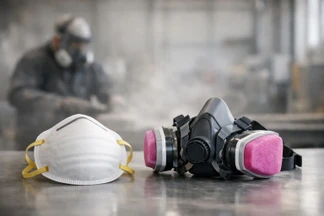
Once the hazard is characterized, match the respiratory protection to the exposure. For many particulate hazards, buyers will compare disposable N95s, elastomeric half-mask respirators with particulate filters, full-face respirators, and in some cases powered air-purifying respirators. Each has a place. The right choice depends on required protection factor, compatibility with the rest of the PPE, maintenance capacity, and worker acceptance.
When an N95 is enough, and when it is not
N95 filtering facepiece respirators are common because they are familiar, relatively low cost, and easy to distribute across large crews. For lower-level particulate exposures, they may be an appropriate part of the program. They also simplify inventory compared with reusable systems.
But N95s have limits. They rely heavily on fit, they can become uncomfortable in hot or physically demanding conditions, and they do not provide the same seal integrity or service life as elastomeric options. They are also not the right answer when exposure levels require a higher APF or when facial movement, sweat, and long wear periods lead to repeated adjustment. For buyers managing recurring dust-intensive tasks, the lower unit cost of disposables can become less attractive over time.
When reusable half-mask respirators make more sense
Elastomeric half-mask respirators fitted with appropriate particulate filters are often a better operational choice for routine industrial dust work. They generally provide a more stable seal than disposables, support repeated use, and can be more cost-effective for ongoing programs. In manufacturing, warehousing with powder handling, construction, and food processing support operations, that can matter as much as the technical specifications.
The trade-off is program complexity. Reusable respirators require cleaning, storage, inspection, and cartridge or filter change procedures. If a facility lacks discipline around maintenance, the theoretical benefit can erode quickly. Procurement teams should not just price the facepiece. They should also account for replacement filters, sanitation supplies, and labor tied to program administration.
When to step up to full-face or powered air systems
If the dust hazard is severe, if eye irritation is part of the exposure, or if a higher protection factor is required, full-face respirators may be the better fit. They add face and eye protection while improving assigned protection compared with half-mask units. For certain demolition, silica, or heavy particulate applications, that added margin is worth the extra weight and cost.
Powered air-purifying respirators can also be a strong solution for longer-duration work, heat stress concerns, or workers who struggle with negative-pressure respirators. They reduce breathing resistance and can improve wear compliance. The downside is obvious - higher upfront cost, battery management, more parts, and greater training demands. For some facilities, they are exactly right. For others, they are more system than the task requires.
Fit, facial hair, and actual field use
A respirator that fails fit testing is not a respirator choice. It is a purchasing error. Tight-fitting respirators require medical evaluation, fit testing, and user training under OSHA respiratory protection requirements. That includes understanding seal checks, limitations, and when to remove a respirator from service.
Facial hair remains a persistent issue in many industrial settings. If hair interferes with the sealing surface, a tight-fitting respirator cannot be relied on. This is not a matter of preference. It is a fit and compliance issue. Safety managers need a clear policy and supervisors need to enforce it consistently, especially on multi-trade sites where rules often drift by crew.
Field conditions also deserve more attention than they usually get. Does the respirator interfere with safety glasses? Can workers communicate around forklifts, moving equipment, or process alarms? Does the valve fog eyewear or conflict with face shields? If a respirator creates enough friction in the workday, workers will find ways around it. That is why wear trials can be useful before a large-scale purchase.
Procurement mistakes that create safety problems later
One common mistake is standardizing on a single respirator across every dust-producing task. It looks efficient on paper but often ignores real differences between departments, contaminants, and duration of wear. A warehouse maintenance team, a concrete cutting crew, and a food ingredient handling operation may all need different solutions.
Another mistake is buying to the lowest unit cost without evaluating total program cost. Disposable products can be appropriate, but not always economical for high-frequency use. Reusables can lower recurring cost, but only if the site can maintain them properly. The right purchasing decision balances hazard protection, worker acceptance, inventory control, and replacement cycles.
A third issue is treating respirators as standalone items. They need to work with hard hats, face shields, hearing protection, and eye protection already in use. In cold environments or variable-temperature operations, that compatibility question gets more complicated. Condensation, hooded garments, and layered PPE can all affect respirator performance and worker tolerance. Buyers who source PPE as a system usually get better results than those who buy each category in isolation.
Building a better respirator selection process for industrial dust
For most organizations, the most reliable path is straightforward. Identify the dust hazard with real data where needed. Confirm whether engineering controls are adequate or need improvement. Select respirators based on required protection factor, task duration, and compatibility with the rest of the PPE. Then support that selection with fit testing, training, maintenance procedures, and replacement planning.
This is also where a knowledgeable supplier adds value. Experienced industrial safety partners can help narrow options based on application, compliance requirements, and operational constraints rather than simply pushing the most common SKU. For buyers managing multiple facilities or recurring replenishment, that guidance can reduce mismatched purchases and improve consistency across crews.
The right respirator program does not start with the broadest product range or the cheapest box on the shelf. It starts with a clear view of the dust hazard and the realities of the job. When those two things line up, respiratory protection becomes easier to enforce, easier to replenish, and far more likely to protect the people who have to wear it every day.
If you are reviewing your current PPE program, industrial dust is one area where small selection errors can carry real consequences. A careful choice now usually costs less than fixing a weak program after exposures, failed fit tests, or avoidable downtime.