

May 22nd 2026
How to Choose Freezer Wear for Your Crew
A worker can handle 0°F very differently depending on whether they are picking orders for 20 minutes, loading docks for a full shift, or moving in and out of blast freezer zones all day. That is why how to choose freezer wear is not a simple question of buying the thickest jacket available. The right decision comes from matching insulation, mobility, exposure time, and job hazards to the actual work environment.
For safety managers, warehouse supervisors, and procurement teams, that distinction matters. Overbuilt gear can slow workers down, increase fatigue, and create heat stress during transitions. Underbuilt gear creates the more obvious problem - cold stress, reduced dexterity, lower productivity, and higher injury risk. Good freezer wear should protect the worker without interfering with the job.
How to choose freezer wear based on temperature
Start with the coldest real exposure, not the average building temperature. A facility may operate at 10°F in one zone, -20°F in another, and still require employees to pass through ambient areas, loading docks, and refrigerated staging spaces during the same shift. If you buy gear based on a general facility label like cold storage or freezer warehouse, you can miss the actual hazard.
Temperature rating should be the first screen, but not the only one. A garment rated for sub-zero conditions may be appropriate for one employee and excessive for another if task intensity is different. Workers who stand at inspection stations or operate equipment with limited movement usually need more insulation than workers who are constantly walking, lifting, and handling product.
Exposure duration matters just as much. Short entries into a freezer call for a different approach than sustained occupancy. For brief tasks, lighter insulated outerwear may be enough when combined with thermal gloves and head protection. For long shifts in deep freeze conditions, a full freezer jacket and bib overall system is often the better choice because it protects the core and lower body without leaving gaps.
Match freezer wear to the job, not just the cold
The next step in how to choose freezer wear is looking at what the worker actually does in the garment. A selector, forklift operator, sanitation worker, and dock loader may all work in the same cold facility, but they do not need identical gear.
Forklift operators often need seated comfort, wind resistance, and flexible shoulder movement. Order pickers usually need mobility through the hips and knees, along with enough breathability to prevent overheating during repetitive motion. Workers handling product manually may need freezer wear that layers cleanly with cut-resistant gloves, high-visibility apparel, or waterproof protection.
This is where many purchasing decisions go wrong. Buyers focus on warmth and miss functional details such as reinforced knees, heavy-duty zippers, storm flaps, elastic backs, high collars, or detachable hoods. Those features are not cosmetic. They affect whether the gear holds up over time and whether employees will actually wear it correctly during a full shift.
Prioritize layering and full-body coverage
Freezer wear performs best as a system. A jacket alone will not solve cold exposure if workers are losing heat through the legs, hands, head, or feet. Gaps between garments can also become a problem during bending, reaching, and lifting.
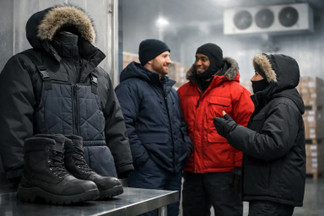
For many operations, the practical baseline is insulated outerwear paired with bib overalls or insulated pants, freezer gloves, thermal head protection, and appropriate cold-weather footwear. If employees are moving between freezer interiors and loading docks, layering becomes even more important because they need protection without becoming overheated during warmer transitions.
Base layers should manage moisture, not hold it. Mid-layers should add warmth without bulk. The outer layer should handle the work environment, whether that means abrasion resistance, wind blocking, water resistance, or all three. When teams complain that freezer wear feels too heavy, the issue is often poor layering strategy rather than the outer garment itself.
Do not overlook hands, feet, and head protection
Cold injuries do not start and stop at the torso. Workers lose dexterity fast when gloves are inadequate, and that affects grip, scan accuracy, equipment handling, and overall safety. If employees cannot perform fine motor tasks in freezer gloves, supervisors often see glove removal on the floor, which creates a different risk altogether.
Footwear also changes the equation. Insulated freezer boots need to provide traction on slick surfaces and enough room for thermal socks without restricting circulation. Tight boots can make feet colder, not warmer. Headwear matters for the same reason. A thermal cap, balaclava, or insulated hood can materially improve comfort and reduce heat loss during long exposure periods.
Consider moisture, condensation, and movement between zones
Cold storage work is rarely dry and static. Condensation, dock drafts, humidity changes, and transitions between freezer and ambient areas all influence garment performance. How to choose freezer wear for these environments means thinking beyond insulation value.
If employees move from inside freezers to humid receiving areas, outerwear may face moisture buildup or fabric wet-out. In food processing and sanitation environments, garments may also need to tolerate more frequent cleaning or contact with wet surfaces. In loading operations, wind resistance may be just as important as thermal insulation.
This is why material selection matters. Durable shell fabrics, water-resistant treatments, and reinforced high-wear areas can extend service life and reduce replacement frequency. The cheapest insulated garment is rarely the lowest-cost option if seams fail early or workers reject the fit.
Fit affects safety and productivity
Poor fit causes more operational problems than many buyers expect. Oversized freezer wear can catch on equipment, reduce visibility, and make climbing in and out of forklifts harder. Undersized garments restrict movement, compress insulating layers, and increase wear at stress points.
Fit also affects compliance. If workers cannot bend, reach, or drive comfortably, they will unzip jackets, skip layers, or wear gear inconsistently. For large crews, it is worth standardizing core garment models while still offering a size range wide enough to accommodate different body types and layering needs.
When evaluating fit, account for what will be worn underneath. A jacket that fits over a T-shirt may not fit the same worker over a thermal base layer and sweatshirt. Procurement teams should think in terms of use conditions, not tagged size alone.
Think about visibility, compatibility, and compliance
In many facilities, freezer wear is only one part of the PPE requirement. Employees may also need high-visibility protection, hard hats, eye protection, gloves for material handling, or specialized garments tied to food processing or sanitation standards. Freezer gear should work with the rest of the PPE program, not compete with it.
That can mean selecting insulated outerwear with high-visibility features for low-light warehouse traffic areas or choosing glove systems that preserve grip while still supporting cold protection. In regulated environments, consistency matters. A garment that is warm but incompatible with the rest of the PPE program creates workarounds, and workarounds create exposure.
For buyers responsible for audits, injury prevention, and repeat ordering, documentation matters too. Product specifications, temperature suitability, construction details, and use-case alignment should be clear enough to support internal approval and replenishment decisions.
How to choose freezer wear for purchasing at scale
A single supervisor can sometimes solve cold-weather complaints by ordering a few heavier jackets. That approach breaks down fast across multiple shifts, job roles, and locations. If you are buying for a team, build the program around exposure categories.
Group employees by temperature range, time in freezer conditions, activity level, and task type. From there, assign a standard gear package for each category. This reduces guesswork, simplifies reordering, and makes it easier to manage replacement cycles. It also helps control spend because you are not over-equipping low-exposure roles or under-equipping high-risk ones.
It is also smart to consider durability by role. Employees doing repetitive lifting, equipment operation, or work around pallets and racking will wear garments differently than staff in lower-abrasion environments. One freezer jacket may be ideal for static cold exposure, while another is better for constant movement and rough contact.
ASA, LLC works with buyers who need that kind of role-based selection because freezer PPE is rarely one-size-fits-all in active industrial settings. The best purchasing decisions usually come from matching the gear package to the operation instead of treating all cold environments the same.
Common mistakes to avoid
The biggest mistake is buying by temperature alone. The second is ignoring duration and activity level. After that, the usual problems are incomplete coverage, poor glove selection, and fit issues that lead to noncompliance.
Another common error is treating freezer wear as seasonal gear instead of operational PPE. In cold storage, food logistics, and freezer warehouse environments, this is daily protection tied directly to worker performance and continuity. When the gear is wrong, you do not just see discomfort. You see slower picking, more breaks, handling errors, and preventable exposure complaints.
The right freezer wear should help crews stay warm, mobile, and productive through the actual conditions they face. If you evaluate temperature, task, duration, layering, fit, and PPE compatibility together, the decision gets much clearer - and the results hold up better on the floor.