

Jun 12th 2026
Face Shields vs Goggles on the Job
A grinder throws off fine metal fragments, a washdown line sends chemical splash sideways, or a forklift crew moves through dusty aisles during a busy shift. In those moments, face shields vs goggles is not a minor PPE question. It affects injury risk, comfort, compliance, and whether workers keep protection on for the full task.
For safety managers and procurement teams, the right answer is rarely one product replacing the other. Face shields and goggles protect differently, and choosing the wrong one can leave a serious gap. The key is matching the equipment to the hazard, the work environment, and the required standard.
Face shields vs goggles: the core difference
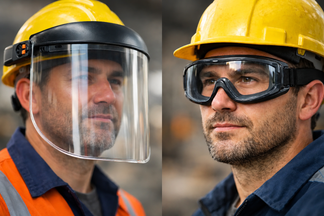
The simplest distinction is coverage versus seal. A face shield covers much more of the face, usually from forehead to below the chin and often across the width of the face. Goggles protect the eye area with a close-fitting design that helps block particles, splash, and contaminants from reaching the eyes directly.
That difference matters because many industrial hazards do not travel in a straight line. Dust can drift under open eyewear. Liquid splash can reach the eye from the side. Flying debris can strike the face and the eye area at the same time. A face shield helps protect facial skin and can reduce direct exposure to larger debris or splash, but by itself it usually does not provide the same sealed eye protection as goggles.
In most industrial applications, goggles are the primary eye protection and a face shield is secondary protection when the hazard extends beyond the eyes.
When goggles are the better choice
If the main hazard is to the eyes, goggles are often the more appropriate starting point. They are designed to fit close to the face and create a more controlled barrier around the eyes than standard safety glasses or a face shield alone.
Goggles are especially useful in environments with airborne dust, powder handling, liquid splash, chemical transfer, and tasks where particles can rebound or circulate. In pharmaceutical and vitamin manufacturing, for example, powdered materials and liquid ingredients can create exposure from multiple directions. In food processing and sanitation work, splash hazards may come from hoses, spray nozzles, or cleaning chemicals. In glass, sheet metal, and maintenance tasks, fine fragments can bypass more open forms of protection.
Indirect-vent goggles can help reduce splash entry while improving airflow. Non-vented chemical goggles provide a tighter barrier where liquid or vapor concerns are higher, though heat buildup and fogging may increase. That trade-off matters on long shifts. If workers remove fogged eyewear because they cannot see clearly, the protection program breaks down.
For that reason, comfort and anti-fog performance should be part of the selection process, not an afterthought.
When a face shield is the better choice
A face shield becomes valuable when the hazard includes more than direct eye contact. It adds coverage to the nose, mouth, cheeks, and often part of the neck area, depending on the design. That extra coverage can be important for grinding, cutting, chipping, sanitation, chemical splash work, and certain energized or high-heat tasks where facial exposure is a concern.
In maintenance shops, fabrication areas, and construction environments, a face shield can intercept larger flying debris before it reaches the face. In washdown and chemical handling operations, it can reduce splash contact across a broader area. In healthcare-adjacent or contamination-control settings, it may also serve as a barrier against direct droplet exposure, depending on the task and facility protocol.
But a face shield has a clear limitation. Because it is open around the sides and bottom, it should not be treated as stand-alone eye protection for most impact or splash hazards unless the task, standard, and product design specifically allow it. That is where many PPE programs run into trouble. Workers assume more coverage means more protection in every direction. It does not.
Why many jobs require both
For higher-risk tasks, the real comparison is not face shields vs goggles as either-or. It is whether the task calls for goggles alone or goggles plus a face shield.
This is common in chemical handling, splash-intensive sanitation, grinding, and operations where particles and liquid can reach the worker at different angles. Goggles protect the eyes with a close fit. The face shield adds another layer for the rest of the face and helps reduce the force or volume of what reaches the goggles.
That layered approach is often the best choice for hazardous processes because it addresses both direct eye injury and broader facial exposure. It also aligns better with the way real incidents happen. A splash event rarely lands neatly in one small area. A grinding incident may involve both fine particulate and larger fragments. PPE selection should reflect that reality.
Compliance and standards matter
For industrial buyers, this decision should always be tied back to hazard assessment and applicable standards. OSHA requires employers to provide suitable eye and face protection wherever employees face hazards from flying particles, molten metal, liquid chemicals, acids, caustic liquids, chemical gases, vapors, or potentially injurious light radiation.
That means the product category alone is not enough. You need to verify that the specific goggle or face shield is appropriate for the exposure and complies with relevant performance requirements, including ANSI/ISEA Z87.1 where applicable. Markings, impact ratings, splash protection characteristics, lens material, visor thickness, and compatibility with other PPE all matter.
For procurement teams managing multiple sites, standardizing around compliant products with clear use-case guidelines reduces confusion. It also helps during training, audits, and replenishment. The less guesswork workers face at the PPE station, the more consistent the protection program becomes.
Fit, compatibility, and worker acceptance
On paper, the right PPE choice can still fail on the floor if it does not fit the rest of the system. Goggles need to work with hard hats, respirators, hearing protection, and cold-weather headwear where applicable. Face shields need suspension systems that remain stable during movement and do not interfere with other required equipment.
This is especially relevant in cold storage, outdoor winter operations, and variable-temperature facilities. Temperature swings can increase fogging, reduce comfort, and lead workers to loosen or remove eye protection. In those settings, lens coatings, ventilation style, and strap performance can have as much operational impact as the protective rating itself.
The same applies in high-output facilities using automation, robotics, and maintenance diagnostics. Workers move between tasks quickly, and PPE that is awkward to don, hard to clean, or incompatible with communication gear tends to get bypassed. A practical selection process looks beyond catalog specs and asks whether crews can realistically wear the equipment correctly for the whole task.
Common selection mistakes
One common mistake is using a face shield alone for grinding or chemical splash because it feels more substantial. Another is selecting goggles for all eye hazards without considering whether the rest of the face also needs protection.
A third issue is buying for price only. Low-cost eye and face protection may check a box at purchase, but if it scratches easily, fogs constantly, or fails under harsh cleaning routines, replacement rates and non-compliance can rise quickly. For larger organizations, that turns into a cost control problem as well as a safety problem.
It also helps to avoid broad rules like “goggles for wet work” or “face shields for fabrication.” The task details matter. What is the splash volume? Is there dust, chips, vapor, or impact? Does the worker also wear a respirator? Is the job brief or continuous? Those factors change the answer.
How to choose the right protection for your crew
Start with the hazard, not the product. Identify whether the exposure is impact, dust, splash, chemical contact, heat, or a combination. Then determine whether the risk is limited to the eyes or includes the full face.
If the hazard is primarily to the eyes and can come from multiple angles, goggles are often the correct base layer. If the task adds broader facial exposure, move to goggles plus a face shield. If the operation involves large debris or splash but no sealed eye protection underneath, stop and verify whether the setup actually meets the task requirement before approving it.
For multi-site buyers, it helps to create task-based PPE matrices so supervisors and employees know when goggles are enough and when face shields are mandatory in addition. That reduces inconsistent practices between departments and helps support training.
ASA, LLC works with professional buyers who need this level of specificity because industrial PPE decisions are rarely generic. The right selection supports compliance, reduces injury exposure, and keeps crews productive without constant rework.
The best closing test is simple: if something strikes, splashes, or drifts past the outer layer, what still protects the eyes? If the answer is nothing, the PPE choice probably needs another look.