


Jun 14th 2026
Excavation Safety & Competent Person Training
A trench can look stable right up to the moment it fails. That is why excavation safety & competent person training is not a paperwork exercise. For contractors, utility crews, municipal teams, and site supervisors, it is one of the clearest lines between a controlled excavation and a fatal one.
Excavation work stays high risk because conditions change fast. Soil type shifts within a few feet. Water accumulates after overnight rain. Spoil piles creep too close to the edge. Equipment vibration affects wall stability. A crew that was working in acceptable conditions at 7:00 a.m. can be exposed to a different hazard profile by mid-morning. Training matters because someone on site has to recognize those changes, act on them, and stop work when the trench no longer meets safe conditions.
What competent person training actually means
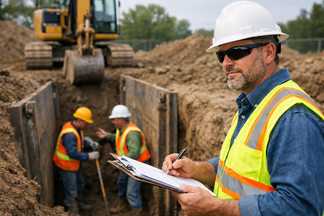
In OSHA terms, a competent person is not just the most experienced worker on the crew or the person who has been around trenches the longest. The role has a specific function. That individual must be capable of identifying existing and predictable hazards in the surroundings or working conditions and must have authorization to take prompt corrective measures.
That second part gets overlooked. A person may know what is wrong and still not be functioning as a competent person if they cannot require corrective action, remove workers from the trench, or stop the work. Training should build both hazard recognition and decision-making authority into the role.
For excavation operations, that usually means the competent person is responsible for soil analysis, protective system selection, site inspections, and ongoing reevaluation as conditions change. The role is active, not passive. It requires judgment before entry, during work, and after events that could affect stability, such as rain, nearby traffic, or utility work in adjacent areas.
Why excavation safety & competent person training matters on active jobsites
The most obvious reason is cave-in prevention, but that is only part of the picture. Excavation hazards also include falls, hazardous atmospheres, falling loads, mobile equipment interaction, utility strikes, and water intrusion. A trench does not have to collapse completely to injure or kill someone.
Training is valuable because it improves field decisions under pressure. Crews often work against production schedules, weather windows, and utility restoration deadlines. In those situations, unsafe shortcuts usually sound practical. Go in for just a minute. Finish this one tie-in before resetting the shield. Work around the seepage and pump it later. A trained competent person is expected to recognize when those decisions move from inconvenient to unacceptable.
There is also a procurement and operations angle here. Safety managers and buyers are not just supporting compliance. They are supporting a system that has to function every day in changing field conditions. If the trained person does not have access to the right trench boxes, ladders, high-visibility apparel, head protection, hand protection, and site control equipment, training alone will not hold the line. Competence in the field depends on both knowledge and available gear.
The core elements a competent person must be able to assess
A good training program should teach more than definitions. It should prepare someone to evaluate real excavation conditions with consistency.
Soil classification and stability
This is one of the most important skills because protective system choices depend on it. Stable rock, Type A, Type B, and Type C soils do not behave the same way. Type C soil, which is common in many disturbed or wet conditions, requires more conservative protection. The problem is that crews often rely on visual assumptions when they should be testing and classifying.
Training should cover both visual and manual analysis methods, and it should make clear that previously disturbed soil cannot be treated like undisturbed material just because it appears compact. That distinction changes sloping, benching, and shielding decisions.
Protective systems
The competent person needs to understand when sloping, benching, shoring, or shielding is appropriate and when one option creates limits the crew cannot ignore. A trench shield, for example, is not a universal fix. It has to be the right size, installed correctly, used according to tabulated data or manufacturer requirements, and positioned to protect workers where they are actually exposed.
Training should also address the trade-offs. Sloping may be practical on open sites with room to work, but not in urban utility corridors or tight rights-of-way. Shielding may support productivity in a narrow footprint, but only if access, placement, and movement are managed properly.
Inspections and changing conditions
OSHA expects excavations, adjacent areas, and protective systems to be inspected by a competent person daily and as conditions change. Effective training emphasizes that inspections are not a one-time box to check before the shift starts.
Rainfall, freeze-thaw cycles, surcharge loads, traffic vibration, and dewatering issues can all change the excavation hazard profile. The competent person needs to know what to look for and when a condition requires immediate correction or evacuation.
Access, egress, and exposure control
If a trench is 4 feet deep or more, workers need safe means of egress, such as a ladder, ramp, or stairway, placed so they do not have to travel excessive distance to exit. That sounds straightforward, but in the field, access points get moved, buried, blocked, or overlooked during quick task changes.
Training should reinforce that safe entry and exit are part of the protective system, not an extra convenience. The same applies to spoil pile placement, barricades, high-visibility clothing for workers exposed to traffic or equipment, and controls around suspended loads.
What strong excavation safety training looks like
Not all training delivers the same result. Some programs give workers general awareness but do not prepare a person to evaluate a trench on a live project. Others are technically solid but disconnected from how crews actually work under schedule pressure.
The best excavation safety & competent person training connects OSHA requirements to field conditions. It should use trench scenarios, protective system examples, and changing-site decision points rather than relying only on classroom definitions. A strong program also explains documentation expectations, because if a hazard is identified, the corrective action should be clear, timely, and defensible.
For employers, the question is not simply whether someone attended a course. The better question is whether that person can assess soil, identify hazards, select or verify the protective approach, and stop work without hesitation when conditions are unsafe. That is the performance standard that matters on site.
Training is only one part of the control plan
A trained competent person can still be undermined by weak execution. If crews do not have trench safety equipment available when needed, or if basic PPE is inconsistent across teams, field decisions get compromised. Workers dealing with poor visibility, inadequate gloves, damaged hard hats, or limited eye protection are already operating with gaps before they enter the excavation zone.
This is where purchasing discipline matters. Safety managers and procurement teams should treat excavation work as a system of controls, not a single product order or annual training event. The competent person needs dependable equipment, replacement PPE, and site-ready stock that matches the actual hazards crews face.
For organizations managing multiple crews or facilities, standardization helps. The more consistent the equipment, inspection expectations, and corrective-action authority are across sites, the more likely training will translate into action. That operational consistency is often what separates a compliant policy from a reliable field practice.
ASA, LLC works with buyers who need that kind of practical alignment between compliance requirements and job-ready PPE, especially in environments where timing, hazard exposure, and replenishment all affect safety performance.
Common gaps employers should fix
One of the biggest mistakes is assigning the competent person role by title instead of capability. A foreman may be the logical choice, but only if they have the training and authority to carry out the role properly.
Another gap is treating inspections as routine when they should be condition-driven. If weather shifts, nearby excavation begins, or heavy equipment changes the loading near the trench edge, the inspection needs to reflect that reality.
The third common issue is overconfidence with familiar work. Utility repair crews and experienced site teams can become less cautious on repetitive jobs because the task feels normal. But excavation hazards do not care whether the crew has done the same kind of cut 200 times before. Predictability in the schedule does not mean predictability in the soil.
Choosing training with the jobsite in mind
The right program depends on the work. A utility contractor in a congested roadway environment may need stronger emphasis on traffic exposure, utility locating, and limited-space protective systems. A municipal public works team may need more focus on variable soil and changing weather. A contractor supporting underground cable or fiber installation may need training that fits narrow, repetitive excavations with frequent setup changes.
That is why the best decision is rarely the cheapest or shortest course. It is the one that best reflects the actual conditions your crews face and gives the designated person the confidence to make difficult calls in real time.
Excavation work will always involve uncertainty. The goal is not to remove every variable. It is to make sure the person responsible for safety in and around the trench can recognize the hazard, has the authority to act, and has the right equipment behind the decision. That is what keeps a trench from becoming the worst moment on the jobsite.