

Jun 15th 2026
Confined Space Entry: What Crews Need
A tank looks idle until someone has to climb inside it. Then the hazard profile changes fast. Confined space entry is one of those tasks where routine maintenance, cleaning, inspection, or repair can turn serious if the permit process, atmospheric testing, communication, and rescue planning are not handled with discipline.
For safety managers, plant supervisors, and PPE buyers, the challenge is not simply knowing that confined spaces are dangerous. It is making sure the crew enters with the right controls, the right equipment, and the right understanding of what can change once work begins. A space that tested safe at the start of the shift can become oxygen-deficient, accumulate toxic vapors, or create an engulfment hazard as conditions shift.
What counts as confined space entry
A confined space is not just any tight work area. In OSHA terms, it is a space large enough for a worker to enter and perform assigned work, with limited or restricted means for entry or exit, and not designed for continuous occupancy. Think tanks, pits, vaults, silos, bins, process vessels, manholes, and some crawl spaces.
The more important distinction for most employers is whether it is a permit-required confined space. That is where risk and procedure tighten up. If the space contains or has the potential to contain a hazardous atmosphere, material that could engulf an entrant, inwardly converging walls or a floor that slopes and tapers, or any other recognized serious safety or health hazard, it typically moves into permit-required territory.
That distinction matters because the controls, documentation, and equipment expectations are different. A non-permit space may be manageable through basic precautions. A permit-required confined space demands a more formal system with assigned roles, verification steps, and rescue readiness.
Why confined space entry fails in the field
Most confined space incidents are not caused by a single dramatic mistake. They usually come from a chain of smaller failures that line up at the wrong time. The permit is rushed. Isolation is incomplete. The air is tested once but not monitored continuously. A contractor assumes the host employer has handled lockout. An attendant gets pulled away to deal with something else.
There is also a recurring problem with familiarity. Crews who have entered the same vessel dozens of times can start treating the job as routine. That is when a process upset, leftover residue, temperature change, or cleaning chemical can catch people off guard. For facilities with rotating shifts or contractor turnover, inconsistency becomes another risk factor. A written program may be solid on paper and still break down during execution.
Rescue is another weak point. Too many sites still rely on a vague plan rather than an actual, practical rescue capability. If the only strategy is calling 911 and hoping municipal responders can manage a technical confined space rescue in time, the plan is probably not adequate for the hazard.
The core controls that make confined space entry safer
Safe confined space entry starts before anyone reaches for a harness or opens a hatch. Hazard evaluation comes first. The employer needs to identify the space, classify it correctly, and understand what can go wrong before, during, and after entry. That includes atmospheric hazards, mechanical energy, product residue, line contents, thermal hazards, moving parts, and visibility or communication limitations.
Isolation is where many programs succeed or fail. Lockout and tagout must address all energy sources that could affect the entrant. That may include electrical, hydraulic, pneumatic, steam, chemical, and material flow hazards. Blank-offs, blinds, line breaking controls, and mechanical disconnection may be needed depending on the system. Simply shutting a valve is not always enough.
Atmospheric testing is not a box-checking exercise. Initial testing should verify oxygen content, flammable gases or vapors, and toxic contaminants in the proper sequence with a calibrated instrument. In many spaces, continuous monitoring is the safer approach because atmospheres can change as work progresses, especially during welding, cleaning, coating, or chemical use. The monitor itself needs to match the hazard. A standard four-gas meter is common, but it may not be sufficient if the process involves specific toxic substances.
Ventilation can control some atmospheric hazards, but it has limits. Forced air may improve conditions, yet it should never be treated as a substitute for evaluating source hazards or for ongoing monitoring. In some spaces, ventilation changes the atmosphere enough to permit work. In others, it may be ineffective or may even disturb residues and increase exposure.
Permit-required confined space entry and assigned roles
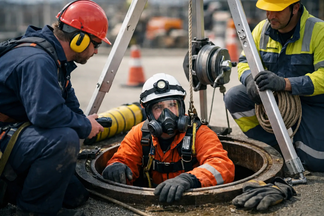
A permit-required confined space program depends on role clarity. The entry supervisor verifies that conditions are acceptable, authorizes entry, and ends the permit when work is complete or conditions change. Authorized entrants enter the space, understand the hazards, use equipment correctly, and exit when ordered or when warning signs appear. The attendant stays outside, tracks the entrants, maintains communication, and initiates emergency response steps without entering the space.
That last point deserves emphasis. Attendants should not become rescuers unless they are specifically equipped, trained, and authorized under the rescue plan. Secondary fatalities are a known pattern in confined space incidents because a nearby worker reacts instinctively and enters without protection.
The permit itself should reflect the reality of the job, not just satisfy documentation requirements. It needs to identify the space, hazards, isolation methods, acceptable entry conditions, test results, duration, communication procedures, equipment requirements, and rescue method. If hot work is involved, the permit should address how that activity changes the risk profile.
PPE and equipment for confined space entry
There is no single PPE package that fits every confined space entry. Equipment selection depends on the hazards present and on whether the controls in place reduce the space to acceptable entry conditions. That said, certain categories come up repeatedly.
Head protection, eye protection, hand protection, protective clothing, and safety footwear need to match both the task and the environment. In a pharmaceutical or food processing plant, contamination control may shape apparel choices. In chemical handling or wastewater applications, splash resistance and material compatibility become more important. In hot, wet, or abrasive spaces, durability and grip matter as much as basic compliance.
Respiratory protection depends entirely on exposure conditions and program requirements. If atmospheric hazards cannot be controlled to acceptable levels, entry may require supplied air or SCBA rather than an air-purifying respirator. That is not a purchasing detail. It changes fit testing, medical evaluation, training, and rescue planning.
Fall protection and retrieval systems are often part of the setup, especially for vertical entries. A full-body harness with a retrieval line connected to a mechanical device can support non-entry rescue in some configurations. But even here, it depends. Internal obstructions, narrow openings, or the entrant’s work position may limit retrieval effectiveness. Equipment should be chosen around the actual geometry of the space, not just the general category.
Lighting, intrinsically safe communication devices, portable barriers, tripod or davit systems, and calibrated gas detection instruments are just as critical as wearable PPE. Procurement teams should look at confined space entry as a system purchase, not a collection of disconnected items.
Training, contractors, and the reality of mixed worksites
Training has to be specific enough to change behavior. General awareness is not enough for permit-required entries. Workers need to understand the hazards of the particular spaces on site, how monitors behave, how ventilation affects conditions, what alarm thresholds mean, and when to stop work.
Contractor management adds another layer. Host employers and contractors must exchange hazard information and coordinate responsibilities. If one party assumes the other handled atmospheric testing, isolation, or rescue capability, the exposure gap can be serious. This is common during shutdowns, tank cleaning, utility work, and maintenance projects where multiple trades are moving at once.
For facilities integrating robotics, automated systems, or predictive maintenance technology, there is a trade-off worth noting. Better sensor data and condition monitoring can reduce unnecessary entries by helping teams diagnose equipment without sending someone inside. But when entry is still required, digital tools do not replace permit discipline. They support it.
Building a purchasing standard that supports compliance
For organizations outfitting teams across multiple plants or job sites, standardization helps. Approved monitor types, harness configurations, signage, protective clothing categories, and replacement intervals reduce confusion and improve training consistency. The right standard also makes replenishment faster and keeps sites from improvising with whatever happens to be available.
This is where working with a safety supplier that understands regulated industrial environments can make a measurable difference. Buyers do not just need product availability. They need equipment aligned with OSHA expectations, task hazards, and the practical demands of maintenance, production, sanitation, utilities, and emergency response.
Confined space entry will never be a casual task, and it should not be treated like one. When crews have the right permit process, clear roles, calibrated instruments, hazard-matched PPE, and a rescue plan built for the real space, entry becomes more controlled, more compliant, and far less dependent on luck. The best time to tighten that system is before the next hatch is opened.