


May 16th 2026
Choosing a Food Transportation Blankets Supplier
A missed temperature target does not always start in the trailer. Often, it starts with a poor packaging decision at the dock. That is why choosing the right food transportation blankets supplier matters for food processors, distributors, commissaries, cold-chain operators, and procurement teams responsible for product integrity and shipment consistency.
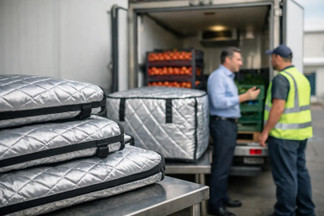
Food transportation blankets are not a generic accessory. In many operations, they are part of the control strategy that helps protect temperature-sensitive product during staging, loading, cross-docking, local delivery, and short-haul movement. If blankets tear too quickly, absorb moisture, fit poorly, or fail under repeated use, the result can be product loss, labor inefficiency, and avoidable replacement costs.
What a food transportation blankets supplier should actually solve
A qualified supplier should do more than stock insulated covers. The real job is helping buyers match blanket construction, size, and thermal performance to the way product moves through their operation. That includes understanding whether the blankets are used for palletized loads, roll cages, carts, combo bins, or direct product coverage during transfer.
This is where many buying decisions go wrong. A lower unit price can look attractive until blankets start failing after repeated loading cycles or become difficult to clean in food environments. For procurement teams, the better measure is total use value - service life, fit consistency, handling speed, storage efficiency, and how well the product supports temperature protection in actual working conditions.
A strong supplier should also understand the operational differences between frozen, refrigerated, and ambient-sensitive shipments. A blanket used to reduce temperature gain on frozen goods moving across a hot loading yard may need a different construction than one used to protect refrigerated product during local delivery stops. The use case drives the specification.
Key product factors to review with a food transportation blankets supplier
Thermal protection is the obvious starting point, but it is not the only one. Buyers should look at insulation type, outer shell strength, seam quality, edge binding, and closure design. In warehouse and transport environments, blankets are dragged, folded, stacked, and reused constantly. Weak stitching and light-duty material usually show up as early failure points.
Fit also matters more than many teams expect. Oversized blankets can slow handling and create inconsistent coverage. Undersized blankets leave corners and top surfaces exposed. If your operation relies on standard pallet dimensions, carts, or bins, the supplier should be able to recommend sizing that matches those footprints closely enough to support repeatable use.
Moisture behavior is another practical concern. In food environments, condensation, washdown conditions, and cold-surface contact all affect blanket performance. Some materials are easier to wipe down and return to service, while others can hold moisture and degrade faster in repeated use. The right choice depends on whether blankets are used in dry transfer zones, freezer staging areas, or mixed-temperature loading environments.
Then there is handling speed. If crews need to cover and uncover loads quickly, closures and blanket weight matter. A blanket that performs well thermally but slows down every outbound shipment may create labor drag. For high-volume operations, usability is not a minor detail. It is part of the buying decision.
Supplier capability matters as much as blanket construction
For industrial and institutional buyers, product quality is only half the equation. The supplier also needs to support repeat purchasing, bulk quantities, and dependable replenishment. If your team manages multiple facilities or seasonal volume swings, inconsistent availability can become an operational problem very quickly.
A reliable supplier should be prepared to answer straightforward questions about stock position, lead times, pack quantities, and reorder planning. They should also understand that buyers may need blanket programs that align with shipping lanes, site-specific temperature demands, and budget cycles. That is especially true for food processing and logistics teams that cannot afford coverage gaps during peak production periods.
Support on product selection is another differentiator. Some suppliers simply list dimensions and materials. Others can help assess whether a heavier blanket is worth the trade-off in weight, whether reusable covers make sense versus lower-cost replacements, or whether a pallet cover format is better suited than a standard moving-style insulated blanket. For professional buyers, that kind of guidance reduces purchasing mistakes.
Where trade-offs usually show up
There is no single best blanket for every operation. It depends on product temperature, exposure time, handling frequency, sanitation expectations, and the cost of failure.
A heavier insulated blanket may offer better protection, but it can also be harder to deploy quickly on busy docks. A lighter blanket may be easier for crews to handle, but it might not hold up as well in repeated use or warmer loading conditions. Reusable products can lower long-term cost per use, but only if teams have the process discipline to store, inspect, and rotate them correctly.
Price is another area where context matters. If blankets are used occasionally for short transfer intervals, a more economical option may be enough. If they are used daily across multiple shifts, the cheapest option often becomes the most expensive over time because of replacement frequency and inconsistent performance.
For operations under tight food safety controls, cleanability can outweigh other features. A blanket that is hard to maintain may not fit the environment even if the insulation value looks good on paper. Buyers should think through the full work cycle, not just the spec sheet.
Questions procurement teams should ask before ordering
Before selecting a supplier, it helps to define how the blankets will actually be used. How long is the product exposed during staging or transfer? Are the loads uniform or mixed? Is coverage needed for tops only, full pallet wraps, or container-specific applications? Are the blankets handled by forklift teams, drivers, or warehouse associates moving product manually?
Once those answers are clear, the supplier should be able to recommend appropriate dimensions and construction. If they cannot explain why one product is better suited than another, that is a warning sign. Temperature control products should not be sold as one-size-fits-all if the operation clearly is not.
Buyers should also ask about durability expectations, replacement cadence, and whether the supplier commonly supports food industry and cold-chain accounts. Experience in industrial supply matters here. Teams that already understand loading docks, freezer environments, and high-turn inventory tend to provide more useful recommendations than sellers focused only on general packaging.
If your organization buys across categories, there is also value in working with a supplier that understands adjacent needs such as freezer wear, thermal gloves, pallet covers, and PPE used in cold storage and food handling environments. Consolidation does not solve every procurement issue, but it can simplify replenishment and vendor management when the supplier has genuine category depth.
Signs you have the right supplier relationship
The right supplier helps you standardize. They make it easier to keep the same blanket type in use across facilities where the application is similar. They support forecasting instead of forcing last-minute substitutions. They understand that purchasing teams need clear specs, consistent product availability, and fast answers when operations are moving.
You should also expect direct communication about limitations. A dependable supplier does not overpromise temperature protection beyond the product's realistic use conditions. They explain where blankets help, where they have limits, and when another insulated cover format may be a better fit. That kind of honesty is valuable because it protects both the shipment and the purchasing decision.
For many buyers, the best partner is one that treats food transportation blankets as part of a broader operational protection strategy, not as an afterthought. That approach is common among industrial safety distributors with experience in cold environments, where product protection, worker protection, and uptime are connected. ASA, LLC works in that space, supporting buyers who need cold-chain products alongside serious PPE and freezer-rated gear.
Why this category deserves more attention
Food transportation blankets sit in a practical middle ground. They are not a full refrigerated system, and they are not meant to replace active temperature control. But in the right application, they can reduce temperature exposure during vulnerable transfer points, protect product quality, and support a more disciplined cold-chain process.
That makes supplier selection more important than it first appears. A capable partner helps you buy for the real environment, not just the catalog description. When blankets fit the load, withstand the work, and arrive when you need them, they stop being a recurring problem and start doing what they should have done from the beginning - quietly support product protection, labor efficiency, and day-to-day operational control.